Slow-Feeder Bowls for Pit Bulls: Do They Help With Fast Eating?
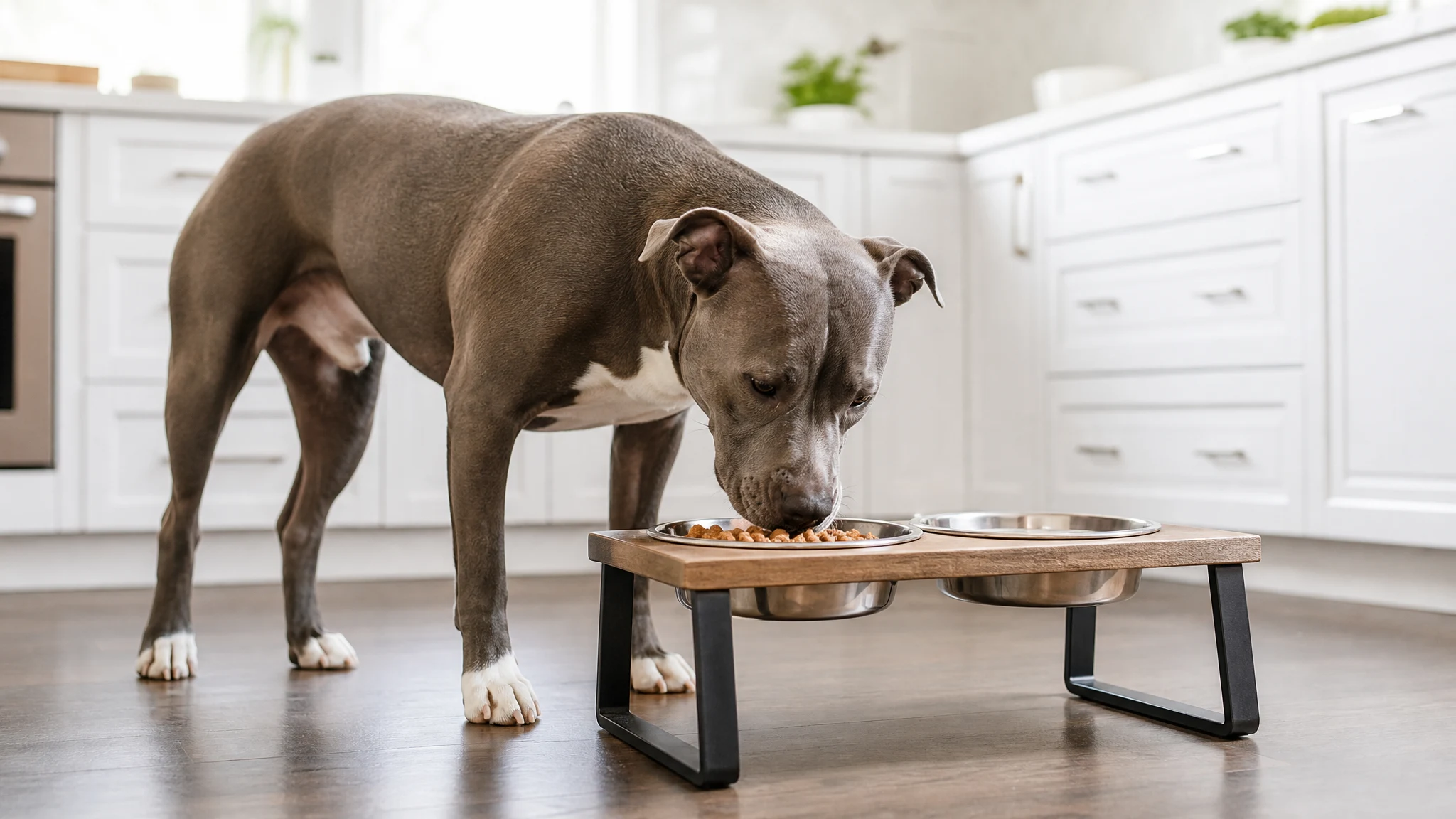
General nutrition information compiled from product labels and published sources, not veterinary advice. Your veterinarian is the right person to choose a diet for your dog, especially one with a health condition.
Many Pit Bulls eat like the bowl might disappear. The food is gone in seconds, and then the dog looks at you as if nothing happened.
A slow-feeder bowl is a popular fix. It has ridges, mazes or raised shapes that make the dog work around the food. This guide shows how to choose one, set up a simple dog feeding station, and judge whether it is working. It also says plainly what a bowl cannot do.
One note on method: this article is built from published label data and general feeding practice. We did not test any bowls with dogs, and we did not run feeding trials or taste tests.
Do slow-feeder bowls help with fast eating?
They may. The idea is simple. When food is spread around obstacles, a dog has to lick and nudge instead of inhaling a mound of kibble. For many dogs that stretches a meal from under a minute to several minutes.
We did not find breed-specific research on slow-feeder bowls and Pit Bulls in our sources, so treat any promise of results with caution. A bowl changes how the food is presented. It does not change why a dog eats fast, and some dogs simply learn to work around the maze.
It also helps to know what a bowl is not. It is not a treatment for any health problem. If your dog vomits after meals, coughs while eating, or seems uncomfortable after eating, call your veterinarian. A vet decides what is right for an individual dog.
Why Pit Bulls are often fast eaters
The United Kennel Club describes the American Pit Bull Terrier as a medium-sized dog. Its breed standard lists adult males at 35 to 60 lb and females at 30 to 50 lb. Hill's Pet Nutrition lists 30 to 60 lb for the breed, with males heavier.
The UKC notes that "Pit Bull" is a type, not a single registry breed, so your dog may differ from these figures. Many dogs of this type are muscular, active and food motivated. That is a common reason meals vanish quickly, but it is not a rule for every dog.
Hill's also lists weight management among the diet-relevant topics for the breed, covering a healthy weight and lean muscle. A fast eater who is also getting extra treats can gain weight without anyone noticing. Slowing meals helps you notice how much your dog really eats, but it does not replace measuring.
Materials you will need
- A slow-feeder bowl. Choose one sized for a medium dog, with shallow ridges rather than tall, sharp ones.
- A non-slip mat. This keeps the bowl from sliding across the floor.
- A kitchen scale or a level measuring cup. A scale is the most accurate. Royal Canin notes on its pages that grams are the most accurate form of measurement and cups are approximate.
- Your dog's regular food. Do not switch foods just to try a bowl.
- A timer or phone clock. You will use it to note how long meals take.
- A water bowl. Fresh water should sit nearby at all times.
Step-by-step: set up your dog feeding station
Step 1: Time a normal meal first
Before changing anything, feed one meal in the usual bowl and time it. Write the number down. This is your baseline. Without it, you cannot tell whether the new bowl made any difference.
Step 2: Confirm the amount you are feeding
A slow bowl changes speed, not portions. Check the amount before you start.
Start with the label on your dog's food. Label guides are starting points. For example, the Hill's Science Diet Adult Large Breed dry food lists 3 1/4 cups per day for a 50 lb dog, and says to adjust amounts to maintain optimal weight. Royal Canin's Large Adult page lists about 3 3/8 cups (318 g) per day for a 57 lb dog at moderate activity. These are large-breed formulas used here only to show how label guides read. Your food, and your dog's weight, age and activity, will give a different number.
Calories per cup vary a lot between foods. The Hill's food above lists 365 kcal per cup, while Nom Nom's Beef Mash lists 201 kcal per cup. A cup of one food is not a cup of another. For a full walk-through by age and weight, see our Pit Bull feeding chart by age and weight.
If your dog has a health condition, confirm the amount with your veterinarian.
Step 3: Pick a quiet spot and build the station
Place the mat on a flat floor in a calm corner. Put the slow-feeder on it and the water bowl beside it. Keep the area away from foot traffic and other pets.
If you have more than one dog, feed them in separate spots. Competition makes dogs eat faster, and a slow bowl will not fix that.
Step 4: Introduce the bowl calmly
Let your dog sniff the empty bowl. Then add a few pieces of kibble and let your dog figure it out. Praise quietly when the dog eats. Never push the dog's face toward the food or scold a dog who is confused.
Reward-based handling is the approach recommended by the American Veterinary Society of Animal Behavior (AVSAB). A new bowl should feel like a puzzle, not a punishment.
Step 5: Measure the meal and fill the bowl
Weigh or level the day's portion, then divide it by the number of meals. Many adult dogs do well with two meals a day, but ask your vet if you are unsure. Puppies often eat more often, and the label of a puppy food will give its own schedule.
Pour the meal into the bowl and spread it into the ridges. Do not stack extra food on top, because that defeats the purpose.
Step 6: Time the meal and watch
Start the timer and stay nearby. Watch for frustration, such as pawing, flipping the bowl or giving up. Also watch for gulping that continues anyway.
Compare the time to your baseline. A longer meal is a good sign, though it is not a guarantee that anything else has changed.
Step 7: Adjust and repeat for two weeks
Dogs need time to learn a new routine. Use the same bowl at the same spot for about two weeks, noting the time each day. If the bowl is too hard, try a shallower design. If it is too easy, try a more complex pattern.
Tips for better results
- Start with an easy bowl. A frustrated dog may refuse to eat. Move up to harder patterns later.
- Pick sturdy, chew-resistant material. Pit Bulls are strong chewers, so check the bowl regularly for cracks or loose pieces. Throw it away if it breaks.
- Wash it often. Grooves hold food residue. Clean the bowl daily with hot soapy water.
- Use wet or fresh food with care. Wet and fresh foods can be pressed into some bowls or lick mats. The Hill's Adult Chicken & Barley wet food, for example, is sold in 13 oz cans. Check the brand's page for the feeding guide, and ask your vet if you are unsure. Fresh foods such as Freshpet, Nom Nom and JustFoodForDogs each have their own storage and serving directions on the brand's own pages, so follow those.
- Combine with exercise and play. Some dogs gulp when they are bored or under-exercised. A walk before dinner may help some dogs settle.
- Consider other pacing tools. A snuffle mat, a lick mat or scattering food in a safe area of the yard can also slow things down.
Common mistakes to avoid
- Skipping the baseline. Without a timed meal beforehand, you are guessing.
- Feeding more to "make it worth it." Do not increase portions because the bowl is harder.
- Using a bowl that is too hard. A dog who gets nothing for the effort may start to dislike meals.
- Ignoring signs of illness. Repeated vomiting, retching, a swollen belly or loss of appetite call for a veterinarian, not a new bowl.
- Changing food and bowl at once. If you switch foods, the Hill's puppy food page suggests moving over 7 days by mixing increasing amounts of new food with decreasing amounts of old. Do the bowl change separately so you can tell which change did what.
- Using punishment or harsh tools. Never use shock, prong or choke collars, or dominance methods, around food or at any other time.
Matching the bowl to the life stage
Puppies and adults need different foods. Royal Canin UK gives about 12 months as general guidance for switching a medium-sized dog to an adult diet, though it says it has no Pit Bull specific age. Ask your vet when to switch your dog.
Pit Bulls are a medium breed, so large-breed puppy formulas are generally not needed. Whole Dog Journal notes that some nutritionists use 50 lb as a large-breed cutoff, so a very big individual may be close to it. A vet should confirm which food fits your dog.
Young puppies may do better with a very shallow bowl while they learn. Check the food label for its life-stage statement, and ask the brand or your vet if you are unsure.
What results to expect
Many owners find that a slow-feeder bowl lengthens mealtime. Some dogs may also swallow less air or seem calmer after eating, though we do not have breed-specific research to point to. Results vary a lot from dog to dog.
It is fair to expect a longer meal. It is not fair to expect the bowl to fix a medical problem or guarantee a change in behavior. If the bowl does not help after a couple of weeks, try a different pattern, or ask your vet whether something else is going on.
The Hill's breed page lists hip and elbow dysplasia, skin allergies and weight management among topics tied to diet for this breed. A bowl does not address any of them. Feeding questions about those topics belong with your veterinarian.
Quick recap
- Time a normal meal first.
- Confirm the daily amount using the food label, your dog's weight and activity, and your vet's advice.
- Build a quiet dog feeding station with a mat, a bowl and water.
- Introduce the bowl gently with praise.
- Compare meal times over about two weeks.
- Call your vet about vomiting, discomfort or sudden changes in appetite.
Sources
- United Kennel Club, American Pit Bull Terrier breed standard
- Hill's Pet Nutrition, American Pit Bull Terrier breed page
- Royal Canin UK, when to switch your puppy to an adult diet
- Royal Canin, Large Adult dry dog food
- Hill's Science Diet, Adult Large Breed Chicken & Barley Recipe
- Hill's Science Diet, Puppy Large Breed Chicken & Brown Rice Recipe
- Hill's Science Diet, Adult Chicken & Barley Entree
- Nom Nom, Beef Mash
- Whole Dog Journal, best large breed puppy food