How Much to Feed a Pit Bull: Feeding Chart by Age and Weight
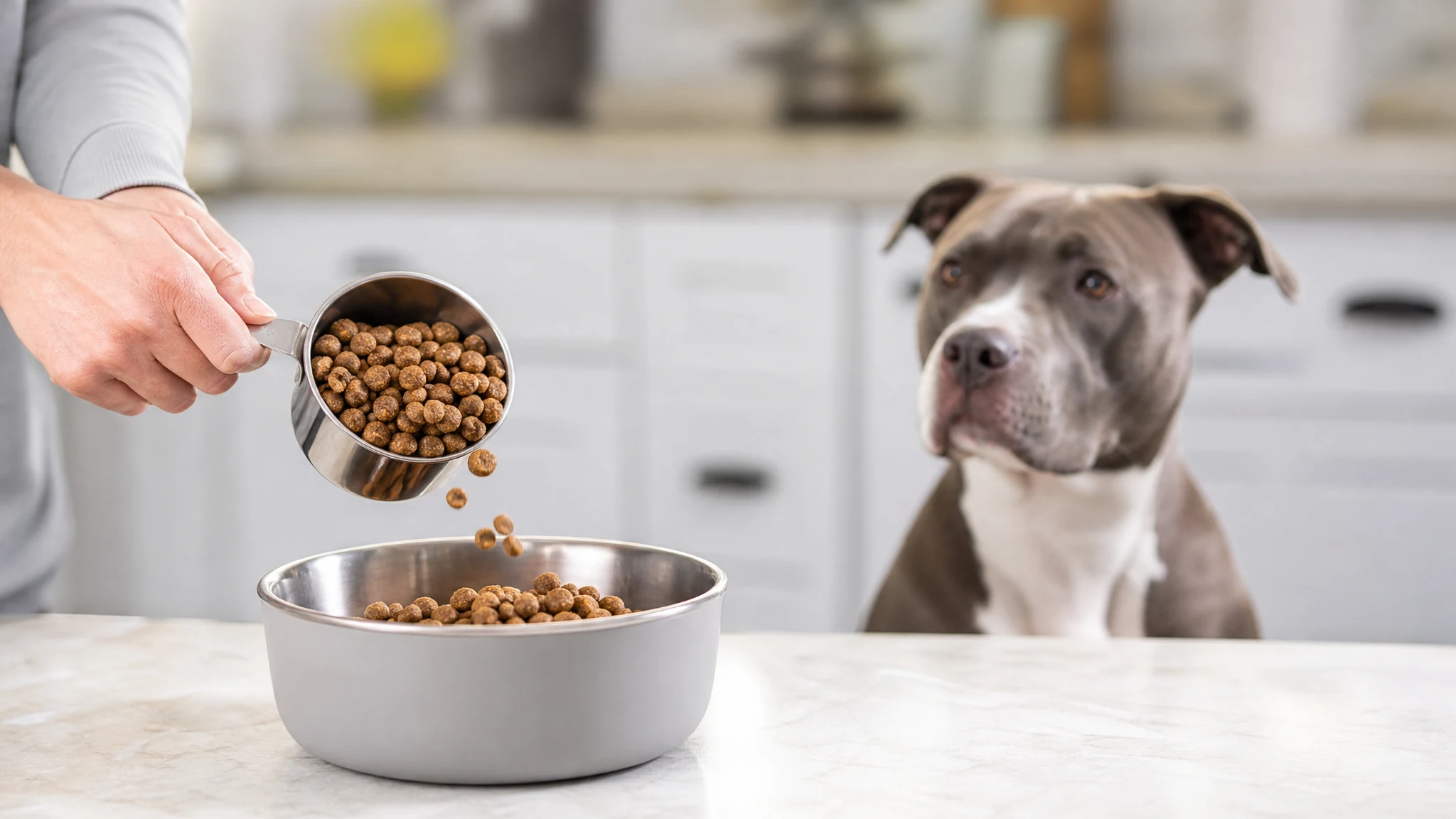
General nutrition information compiled from product labels and published sources, not veterinary advice. Your veterinarian is the right person to choose a diet for your dog, especially one with a health condition.
Owners often ask how much to feed a Pit Bull, and the honest answer is that no single number fits every dog. Pit Bulls vary a lot in size, build and energy. The best amount is the one that keeps your dog at a healthy body condition.
This guide shows how to build a starting amount from the feeding guide on a food's own label. Then it shows how to check and adjust that amount over a few weeks. We compared label data from the brands named below. We did not run feeding trials or taste tests.
First, what size is a Pit Bull?
"Pit Bull" is a type of dog, not a single registry breed. The United Kennel Club recognizes the American Pit Bull Terrier, and its breed standard gives weights by sex. Hill's Pet Nutrition gives a slightly different range on its breed page.
| Source | Adult weight |
|---|---|
| United Kennel Club, males | 35 to 60 lb |
| United Kennel Club, females | 30 to 50 lb |
| Hill's Pet Nutrition breed page | 30 to 60 lb (males heavier) |
Many Pit Bulls are rescues or mixes, so your dog may not match these ranges. Use your dog's actual weight on a scale, not the breed average.
What you need
- The bag, can or package of the food you are feeding, with its feeding guide.
- A kitchen scale that reads in grams or ounces. Weighing food is more accurate than scooping.
- A standard measuring cup, if you prefer to scoop.
- A scale to weigh your dog. A bathroom scale works: weigh yourself, then yourself holding the dog, and subtract.
- A notebook or phone note to log weight, food amounts and treats.
- Your veterinarian's contact details for the final decision.
Step-by-step: how to find the right amount
Step 1: Weigh your dog and note the age
Write down the current weight. Then note whether your dog is a puppy or an adult. Royal Canin UK's guidance on switching from puppy to adult food suggests about 12 months for medium-sized breeds. It does not give a Pit Bull specific age, so ask your veterinarian when your dog should change foods.
Step 2: Pick a food made for your dog's life stage
Look for the AAFCO statement on the label. It tells you the life stage the food is made for. For example, Royal Canin Medium Adult says it is formulated to meet AAFCO nutrient levels for maintenance. Victor Hi-Pro Plus says it is for all life stages except growth of large size dogs (70 lb or more as an adult).
That wording matters for puppies. AAFCO label language, as quoted by Dog Food Advisor, separates growth of large dogs (70 lb or more as an adult) from other growth. Large-breed puppy diets have a stricter calcium maximum of 1.8% on a dry matter basis, compared with 2.5% for other foods, according to Whole Dog Journal. Adult Pit Bulls generally fall below that 70 lb line, so the large-breed puppy rule generally does not apply. A very big individual could be near it, though, and some nutritionists use 50 lb as a cutoff. Your veterinarian should confirm which puppy food suits your dog.
Step 3: Read the feeding guide as a starting point
Every feeding guide is an estimate. Royal Canin says its own guide is only a guide, and that grams are more accurate than cups. Hill's says to adjust amounts as necessary to maintain optimal weight. Treat the number as the first thing you try, not the final answer.
Step 4: Build your chart from the label
Brands publish feeding charts in different forms, and not every chart is in the product information we reviewed. The table below uses only the label figures we have for specific products. If your dog's weight is not listed, find your dog's weight on the chart printed on the package or the brand's own page.
| Product (brand page) | Label calories | Label feeding example |
|---|---|---|
| Hill's Science Diet Adult Large Breed Chicken & Barley (dry) | 365 kcal per cup | 3 1/4 cups per day for a 50 lb dog |
| Royal Canin Large Adult (dry) | 360 kcal ME per cup, as fed (calculated) | About 3 3/8 cups (318 g) per day for a 57 lb dog at moderate activity |
| Royal Canin Medium Adult (dry) | 340 kcal ME per cup, as fed (calculated) | For adults 23 to 55 lb. Use the chart on the brand's page for your dog's weight. |
| Victor High Energy (dry) | 412 kcal per cup | Use the chart on the brand's page. The label note on extra food applies to dogs over 100 lb. |
| Victor Hi-Pro Plus (dry) | 406 kcal per cup | Use the chart on the brand's page. The label note on extra food applies to dogs over 100 lb. |
| Nom Nom Beef Mash (fresh) | 201 kcal per cup (168 g, calculated) | Daily recommendations are a guide and vary with age, weight and activity |
The Hill's 50 lb example and the Royal Canin 57 lb example sit inside the UKC range for males and the Hill's range for the breed. They are label examples for those two foods only. They are not a rule for every Pit Bull of that weight.
Step 5: Compare foods by calories, not by cups
A cup of one food is not the same as a cup of another. By the label figures above, Victor High Energy has 412 kcal per cup and Royal Canin Medium Adult has 340 kcal per cup. If you switch foods and keep the same number of cups, your dog may eat noticeably more or fewer calories.
As a rough illustration, our own arithmetic from the label figures puts the Hill's 50 lb example at about 1,190 kcal per day (3.25 cups at 365 kcal). The Royal Canin 57 lb example comes to about 1,215 kcal per day (3.375 cups at 360 kcal). These are not recommendations. They show that the same weight range can end up in a similar calorie range on different foods.
Fresh and wet foods use other units. The Hill's Science Diet Adult Chicken & Barley canned food lists 369 kcal per 13 oz can, not per cup. Freshpet Vital Chicken Recipe lists 309 kcal per half pound (calculated) and tells you to use the serving indicators on the package. JustFoodForDogs Beef & Russet Potato lists 44 kcal ME per ounce and points to a feeding calculator on its site. Check each brand's page for its own method.
Step 6: Split the daily amount into meals
Most adult dogs do well on two meals a day, though your veterinarian may suggest something different. Puppies usually eat more often. Check the puppy food's label for the number of meals, and ask your veterinarian to confirm it for your dog's age.
Step 7: Score your dog's body condition
Body condition scoring is the best way to tell whether the amount is right. It does not depend on the number on the bag. Many veterinarians use a scale with a rating for too thin, ideal and overweight. Ask yours which scale they use and what score they want for your dog.
You can do a simple home check:
- Ribs: Run your hands along the sides. You should feel the ribs under a thin layer of padding, without pressing hard. If you cannot feel them, your dog may be carrying extra weight. If they stick out sharply, your dog may be too thin.
- Waist: Look down from above. You should see a waist behind the ribs.
- Tuck: From the side, the belly should rise up from the chest toward the hind legs, not hang level or sag.
Pit Bulls are muscular, so some owners misjudge them. A broad chest and thick neck can hide extra fat under the coat. Hill's lists weight management, with a healthy weight and lean muscle, among the diet-related points on its breed page. Feel your dog, not just look.
Step 8: Adjust for activity
The Royal Canin Large Adult example is for moderate activity, and its label says the recommended amount depends on target adult weight and activity level. Nom Nom says its recommendations vary with age, weight and activity. A dog that runs, hikes or does sport may need more than a couch companion of the same weight. A dog recovering from injury or one that is less active may need less.
Change the amount slowly. Many owners start with a small change, such as a modest increase or decrease, then re-check body condition and weight after a few weeks. Your veterinarian can tell you how big a change is reasonable.
Step 9: Switch foods gradually
Hill's suggests moving to a new puppy food over 7 days by mixing increasing amounts of the new food with decreasing amounts of the old. The same approach is common for other changes. A slow switch is easier on most dogs' stomachs. If your dog has vomiting or diarrhea, contact your veterinarian.
Step 10: Log it and re-check
Weigh your dog every couple of weeks at first, and write down the food amount and any treats. Puppies change quickly, so their amounts need frequent re-checking. Adults can be checked monthly once their weight is steady.
Feeding by age
- Puppies (to about 12 months): Use a food made for growth, and follow the puppy label's chart by your dog's weight and age. The amounts we have on file for puppy food are limited, so use the brand's own page and your veterinarian. Hill's Puppy Large Breed Chicken & Brown Rice is made for puppies that will be over 55 lb as adults, and it is not recommended for adult dogs. Ask your veterinarian whether a large breed puppy food or another growth food suits your dog.
- Adults (about 12 months and older): Use an adult or all life stages food. Royal Canin Medium Adult is for dogs 12 months and older at 23 to 55 lb. Royal Canin Large Adult is for dogs over 15 months at 56 to 100 lb. Hill's Adult Large Breed covers ages 1 to 5 years for an ideal weight of 55 to 110 lb.
- Seniors: Hill's Adult Chicken & Barley canned food is not intended for mature adults. Ask your veterinarian about senior needs and amounts. Life expectancy for the breed is 12 to 14 years, according to Hill's.
Tips
- Count treats. Chews, training rewards and table scraps all add calories. Take them out of the day's food if your dog gets many.
- Weigh food in grams when you can. Scoops vary, and a heaping cup can hold much more than a level one.
- Check the AAFCO statement before you buy, and read the whole guide, not just the headline number.
- Use the brand's own page for current label data, because formulas can change.
- Tell your veterinarian if your dog has itchy skin, ear problems or joint concerns. Hill's lists hip and elbow dysplasia and skin allergies among the health issues it mentions for the breed. Diet may be one part of the picture, and a veterinarian decides what is right for an individual dog.
Common mistakes to avoid
- Feeding by breed average. A 35 lb female and a 60 lb male need very different amounts.
- Copying cups across brands. As shown above, calories per cup differ.
- Using a large-breed puppy food by default. Pit Bulls are a medium breed, and a veterinarian should confirm the choice.
- Using an adult-only food for a puppy. Hill's Adult Large Breed is not recommended for large breed puppies, and JustFoodForDogs Beef & Russet Potato is not intended for growing puppies.
- Ignoring the body, trusting only the bag. The label is a start. Your dog's ribs, waist and weight tell you more.
- Making big changes fast. Adjust in small steps and re-check.
- Adding supplements without asking. Check with your veterinarian before adding anything to the bowl.
What results to expect
If the amount is about right, many owners find that their dog holds a steady weight, keeps a visible waist and feels firm and lean under the hands. Energy, stool quality and coat condition can also be signs that the diet is working, though they have many causes. Results vary by dog, and no feeding chart can promise a specific outcome.
Weight changes usually take a few weeks to show. If your dog is gaining or losing weight in a way you did not plan, or if you see ongoing digestive trouble, skin problems or a big change in appetite, talk to your veterinarian.
Label guides are starting points
Every amount in this article comes from a manufacturer's label or a breed organization. It is a starting point. Your veterinarian looks at your dog's age, weight, body condition, health and activity, and sets the amount for that individual dog. If your dog needs a prescription diet, only a veterinarian can prescribe it.
Sources
- United Kennel Club, American Pit Bull Terrier breed standard
- Hill's Pet Nutrition, American Pit Bull Terrier breed page
- Royal Canin UK, when to switch your puppy to an adult diet
- Royal Canin Medium Adult
- Royal Canin Large Adult
- Hill's Science Diet Adult Large Breed Chicken & Barley
- Hill's Science Diet Puppy Large Breed Chicken & Brown Rice
- Hill's Science Diet Adult Chicken & Barley Entree (canned)
- Victor Hi-Pro Plus
- Victor High Energy
- Freshpet Vital Chicken Recipe with Peas, Carrots & Brown Rice
- Nom Nom Beef Mash
- JustFoodForDogs Beef & Russet Potato Recipe
- Whole Dog Journal, best large breed puppy food
- Dog Food Advisor, large breed puppy food and all life stages labels