Reading a Dog Food Feeding Chart: What the Numbers Actually Mean
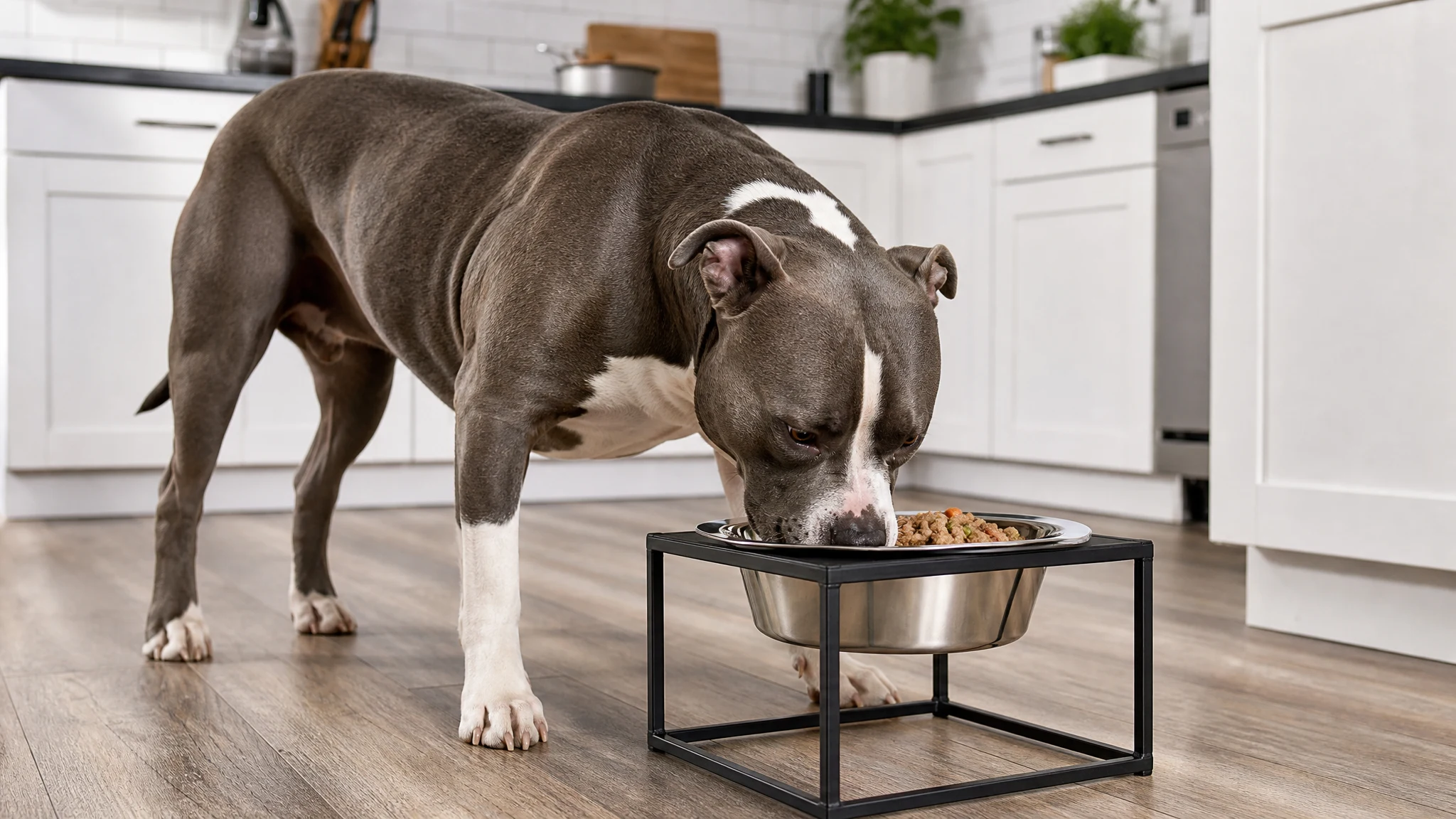
General nutrition information compiled from product labels and published sources, not veterinary advice. Your veterinarian is the right person to choose a diet for your dog, especially one with a health condition.
A feeding chart on a bag looks simple. Find your dog's weight, read across, and scoop. But the chart is only a starting point, and the numbers behind it depend on the food's calories, your dog's age and how active they are.
This guide walks through how to read a dog feeding chart for a Pit Bull, step by step. We compared label data from brand pages. We did not run feeding trials or taste tests.
What you need before you start
- The food bag or the brand's product page, with the feeding chart and the nutrition statement.
- Your dog's current weight, taken on a scale at home or at a vet visit.
- A level measuring cup, or better, a kitchen scale that reads in grams.
- A note of your dog's age and typical daily activity.
- A pen or phone note to track weight and body shape over a few weeks.
Know your Pit Bull's size first
"Pit Bull" is a type, not a single registry breed. The United Kennel Club, which registers the American Pit Bull Terrier, lists males at 35 to 60 lb and females at 30 to 50 lb. Hill's Pet Nutrition's breed page gives a range of 30 to 60 lb, with males heavier.
That is a medium dog. Many charts are built for ranges, so a 45 lb dog may fall between rows. Your dog's own weight, not the breed average, is what you use.
Step 1: Confirm the food fits your dog's life stage
Before reading any chart, check the nutrition statement near the ingredient list. It tells you what the food is meant for.
For example, Royal Canin's Medium Adult label says it is formulated to meet AAFCO Dog Food Nutrient Profiles for maintenance, and the product is aimed at adults 12 months and older, 23 to 55 lb. Royal Canin's Large Adult is for dogs over 15 months and 56 to 100 lb.
Royal Canin UK's guidance on switching from puppy food suggests about 12 months as the adult point for medium breeds. It is general guidance, not a Pit Bull specific age, so ask your vet when your dog should switch.
Also read the large-breed wording. According to Dog Food Advisor, quoting AAFCO label language, foods for growth must say whether they include or exclude growth of large dogs, meaning 70 lb or more as an adult. Victor's Hi-Pro Plus and High Energy labels, for instance, say "all life stages, except for growth of large size dogs." Most Pit Bulls stay under that 70 lb line, but a very big male may come close, so a vet should confirm which puppy food suits your dog.
Step 2: Find your dog's weight on the chart
Charts list a daily amount by body weight. Use your dog's real weight today. Do not use the weight you hope they will reach, unless your vet has set a target for you.
Some charts are tied to ideal weight rather than current weight. Hill's Science Diet Adult Large Breed, for example, is described for dogs with an ideal weight of 55 to 110 lb. If your dog is overweight, the chart row for their current weight may overfeed them.
Here are two label examples, shown only to illustrate how different foods read:
- Hill's Science Diet Adult Large Breed lists 3 1/4 cups per day for a 50 lb dog.
- Royal Canin Large Adult lists about 3 3/8 cups (318 g) per day for a 57 lb dog at moderate activity.
These are different dogs and different foods, so do not treat them as a Pit Bull standard. They show that the same weight can map to different amounts, which is why Step 3 matters.
Step 3: Check the calories per cup
A cup is a measure of volume, not energy. Foods vary in how many calories fit in a cup, so a chart written for one food cannot be used for another.
Here is what the brand pages list:
| Food | Calories listed |
|---|---|
| Royal Canin Medium Adult (dry) | 340 kcal ME per cup, calculated |
| Royal Canin Large Adult (dry) | 360 kcal ME per cup, calculated |
| Hill's Science Diet Adult Large Breed (dry) | 365 kcal per cup |
| Victor Hi-Pro Plus (dry) | 406 kcal per cup |
| Victor High Energy (dry) | 412 kcal per cup |
| Nom Nom Beef Mash (fresh) | 201 kcal per cup, calculated |
Some labels use other units. Hill's wet Adult Chicken & Barley lists 369 kcal per 13 oz can, not per cup. Freshpet and JustFoodForDogs list calories per weight or per pack. For those, follow the brand's own serving guidance and check with the brand if anything is unclear.
Here is the label math. Our own arithmetic on Hill's figures: 3 1/4 cups at 365 kcal per cup comes to roughly 1,190 kcal per day. If you switched to a food with 412 kcal per cup and kept the same cup count, you would feed noticeably more energy. Always use the new food's own chart.
Step 4: Adjust for activity and age
The chart's row is an average. Royal Canin's Large Adult page notes the amount depends on target adult weight and activity level. Nom Nom's guide says amounts may vary with your dog's age, weight and activity level.
A Pit Bull who runs or does dog sports most days may need more than a mostly sedentary one. A senior or spayed or neutered dog may need less. The label does not decide this for you. It gives a start, and you adjust from there.
For a broader walkthrough by age and weight, see our guide to a Pit Bull feeding chart by age and weight.
Step 5: Measure accurately and split the meals
Royal Canin states on its chart that grams are the most accurate form of measurement and that cups are only approximate. A scoop can vary a lot depending on how it is filled, so a scale is more reliable.
Divide the daily total into the number of meals your vet recommends. Many owners use two meals a day for adults. Your vet can advise on schedule for puppies, who usually eat more often.
Count treats and chews as part of the day's food. If you use them for training, take a little out of the bowl.
Step 6: Switch foods slowly
If you change food, Hill's suggests a 7 day transition, mixing increasing amounts of the new food with decreasing amounts of the old. Measure the new food by its own chart during that mix.
Step 7: Watch your dog and adjust
Check your dog's body every week or two. You should be able to feel the ribs under a thin layer of fat, and see a waist from above. Your vet can show you how to score body condition.
Hill's lists weight management, with a focus on a healthy weight and lean muscle, among the diet-relevant topics for this breed. If your dog is gaining or losing weight, change the daily amount a little and recheck. Hill's labels say to adjust feeding amounts as needed to maintain optimal weight. If you are unsure, ask your vet.
Tips
- Weigh your dog on the same scale each time.
- Keep the chart's note on whether it covers puppies, adults or all life stages.
- Compare foods by calories per cup before comparing cup counts.
- Write down the amount you feed so anyone in the home feeds the same.
- Ask the brand directly if a page does not list a number you need, such as kibble size or guaranteed minimums.
Common mistakes to avoid
- Using a large-breed chart for the wrong dog. Hill's Adult Large Breed is not recommended for large breed puppies. Hill's Large Breed Puppy is not recommended for adult dogs.
- Treating the chart as a rule. It is a guide. Your dog's body shape is the real feedback.
- Mixing up as-fed and dry matter numbers. Hill's pages give protein and fat as dry matter averages, not guaranteed minimums. Do not compare those to another brand's guaranteed minimums as if they were the same measure.
- Forgetting extras. Treats, toppers and table scraps add up.
- Changing food overnight. A sudden switch can upset digestion.
Health conditions and your vet
Hill's lists hip and elbow dysplasia and skin allergies among the health topics for the breed. Food labels cannot tell you whether a diet suits a dog with these. If your dog has a health condition, confirm amounts and food choice with your vet before using any chart. Prescription diets are something only a veterinarian prescribes.
We do not give supplement doses. If your vet suggests a supplement, follow their instructions and the product's own label.
What results to expect
If the amount suits your dog, you may see steady body weight, a visible waist and normal energy over several weeks. Stool quality and appetite may also settle. Results vary by dog, and no chart can promise a particular outcome.
If your dog is gaining, losing, hungry all the time or has digestive trouble, call your vet. Do not keep raising or cutting the amount on your own.
Sources
- United Kennel Club, American Pit Bull Terrier breed standard
- Hill's Pet Nutrition, American Pit Bull Terrier breed page
- Royal Canin UK, when to switch your puppy to an adult diet
- Royal Canin Medium Adult
- Royal Canin Large Adult
- Hill's Science Diet Adult Large Breed
- Hill's Science Diet Puppy Large Breed
- Hill's Science Diet Adult Chicken & Barley (wet)
- Victor Hi-Pro Plus
- Victor High Energy
- Nom Nom Beef Mash
- Dog Food Advisor, large breed puppy food and all life stages labels