Meal Prep for Pit Bulls: Batch-Preparing Kibble and Fresh Food
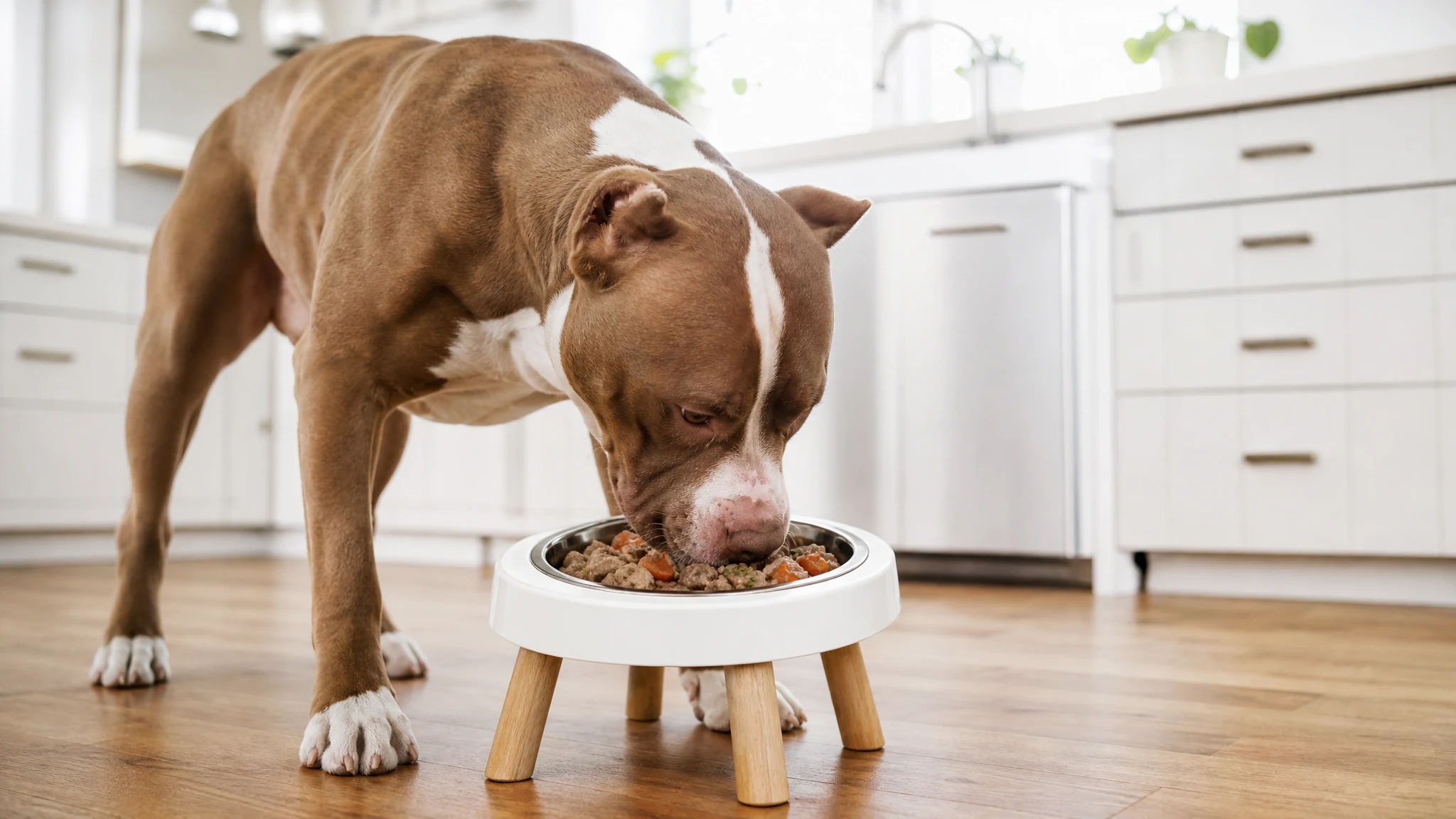
General nutrition information compiled from product labels and published sources, not veterinary advice. Your veterinarian is the right person to choose a diet for your dog, especially one with a health condition.
Dog feeding preparation is easier when you do it once for the whole week. Batch prep means weighing, portioning and labeling meals ahead of time, so each feeding takes seconds and stays consistent.
This guide covers kibble and ready-made fresh food for a Pit Bull. It is not a home-cooking recipe. If you want to cook for your dog, ask your veterinarian first, because a homemade diet has to be complete and balanced to be a safe daily food.
Why batch prep suits a Pit Bull
The United Kennel Club lists the American Pit Bull Terrier as a medium breed, with males at 35 to 60 lb and females at 30 to 50 lb. Hill's Pet Nutrition gives a similar range of 30 to 60 lb. That is a wide spread, so one dog's portion can be quite different from another's.
Hill's also lists weight management, hip and elbow dysplasia, and skin allergies among the diet-relevant health topics for the breed. A measured, repeatable meal makes it easier to watch body condition. Whether any food suits an individual dog is a decision for your veterinarian.
Materials you need
- A kitchen scale that reads in grams. Royal Canin notes that grams are the most accurate way to measure, and cups are only close estimates.
- A measuring cup, only as a backup or to learn what your scale weight looks like.
- Airtight containers or reusable bags, one per meal or one per day.
- A marker and tape for labels (date, meal, dog's name).
- The feeding guide from your dog's food bag or the brand's page.
- A notebook or phone note to track weight and body condition.
Step by step: batch-prepping meals
Step 1: Confirm the right food for your dog's life stage
Read the AAFCO statement on the label. It tells you which life stage the food is formulated for. Royal Canin Medium Adult, for example, is built for dogs 12 months and older, and Royal Canin UK gives about 12 months as general guidance for when medium breeds move to adult food. No Pit Bull specific switch age was found, so ask your veterinarian about your own dog.
Size matters too. AAFCO requires growth and all-life-stages foods to say whether they cover growth of large dogs, meaning 70 lb or more as adults. Dog Food Advisor, quoting AAFCO label language, notes that large-breed growth foods have a stricter calcium maximum of 1.8 percent on a dry matter basis, compared with 2.5 percent for other foods. Most Pit Bulls fall below that 70 lb line, so the large-breed puppy rule generally does not apply. Whole Dog Journal points out that some nutritionists use 50 lb as a cutoff, so a very big individual may sit near it. Your veterinarian should confirm.
Step 2: Find the starting amount from the label
Every food has its own guide, and the numbers vary a lot because foods differ in calories. As examples from brand pages:
- Royal Canin Large Adult lists about 3 3/8 cups (318 g) for a 57 lb dog at moderate activity.
- Hill's Science Diet Adult Large Breed lists 3 1/4 cups per day for a 50 lb dog.
- Victor and Freshpet say to adjust by weight or use the on-package serving indicators.
Treat these as starting points, not targets. Use the guide for your dog's current weight, age and activity level, then adjust. Our Pit Bull feeding chart by age and weight explains how those factors change amounts.
Step 3: Convert the daily amount to grams
Place a container on the scale, zero it, and scoop your usual cup of food. Note the weight. Calories per cup differ widely: Royal Canin Medium Adult lists 340 kcal per cup, Victor Hi-Pro Plus lists 406 kcal per cup, and Nom Nom Beef Mash lists 201 kcal per cup. A cup of one food is not a cup of another, which is why weighing beats scooping.
Step 4: Split the daily amount into meals
Divide the daily total by the number of meals you feed. Many owners use two meals a day, but the right schedule for your dog is something to settle with your veterinarian, especially for a puppy or a dog with a health condition.
Step 5: Portion kibble for the week
Set out seven days of containers. Weigh each portion and seal it. Keep the main bag closed and stored as the brand directs. Many owners keep kibble in its original bag, since it carries the lot number and best-by date.
Step 6: Portion fresh food by the brand's directions
Fresh foods come with their own rules, so follow the brand page.
- Freshpet says to use the on-package serving indicators to slice off the right amount from the roll.
- Nom Nom says its daily recommendations are only a guide and vary with age, weight and activity level.
- JustFoodForDogs points to a feeding calculator, and says thawed sealed meals are used within 7 days, and within 5 days once opened.
Because of those short windows, portion fresh food into a few days at a time, not a full week, unless the brand says otherwise. Check each brand's page for freezing and storage directions, since they differ.
Step 7: Label, store and rotate
Write the date and meal on each container. Use the oldest container first. Wash scoops and bowls between meals, especially with fresh or wet food.
Step 8: Check the results every few weeks
Weigh your dog and feel along the ribs. Hill's lists healthy weight and lean muscle as a goal for the breed. If your dog is gaining or losing without a plan, adjust the portion slightly and tell your veterinarian.
Comparing kibble and fresh food on the label
We compared label data from the brand pages. We did not run feeding trials or taste tests, and nothing here is a ranking.
| Food | Form | Label calories | Prep note |
|---|---|---|---|
| Royal Canin Medium Adult | Dry | 340 kcal per cup | Adult, 23 to 55 lb |
| Victor High Energy | Dry | 412 kcal per cup | All life stages except large-size growth |
| Freshpet Vital Chicken Recipe | Fresh roll | No per-cup figure given | Slice by package indicators |
| Nom Nom Beef Mash | Fresh | 201 kcal per cup | Daily guide varies by dog |
| JustFoodForDogs Beef & Russet Potato | Fresh frozen | 44 kcal ME per oz | Adult maintenance, not for growing puppies |
The brand pages are Royal Canin Medium Adult, Victor High Energy, Freshpet, Nom Nom and JustFoodForDogs. Check each brand for current ingredients and guidance.
Tips for smoother prep
- Prep on the same day each week so it becomes routine.
- Keep a spare day of portions for travel or a missed prep day.
- Change foods slowly. Hill's suggests a 7-day transition, mixing increasing amounts of new food with decreasing amounts of old.
- Count treats and training rewards as part of the day's food.
- Use reward-based training with the meal portions, such as part of a meal for practicing cues.
Common mistakes to avoid
- Scooping by cup only. Cups vary from scoop to scoop and food to food. Weigh instead.
- Using a puppy or large-breed food for the wrong stage. Hill's states its Large Breed Puppy recipe is not recommended for adult dogs, and its Adult Large Breed recipe is not recommended for large breed puppies. Match the food to the life stage on the label.
- Prepping too much fresh food. Respect the brand's use-by window after thawing or opening.
- Treating the label amount as fixed. It is a starting point. Adjust to body condition.
- Mixing foods without a plan. Combining kibble and fresh food changes calories. Reduce each portion so the total still fits your dog's needs, and ask your veterinarian how.
- Adding supplements on your own. Ask your veterinarian before adding anything, and follow their directions.
What to expect
A steady routine may make mealtimes calmer and reduce guesswork. Consistent portions may also make it easier to notice weight changes early. Results vary by dog, and no food or routine can promise a particular outcome.
If your Pit Bull has itchy skin, joint concerns, a weight problem or any health condition, confirm amounts and food choice with your veterinarian. Only a veterinarian can prescribe a therapeutic diet.
Sources
- United Kennel Club, American Pit Bull Terrier breed standard
- Hill's Pet Nutrition, American Pit Bull Terrier breed page
- Royal Canin UK, when to switch your puppy to an adult diet
- Whole Dog Journal, best large breed puppy food
- Dog Food Advisor, large breed puppy food and all life stages labels
- Royal Canin Large Adult
- Hill's Science Diet Adult Large Breed
- Hill's Science Diet Puppy Large Breed
- Victor Hi-Pro Plus