Feeding Stations for Pit Bulls: What to Look for in a Bowl Setup
General nutrition information compiled from product labels and published sources, not veterinary advice. Your veterinarian is the right person to choose a diet for your dog, especially one with a health condition.
A dog feeding station is just a set place where your dog eats, with the right bowls, a mat, and a way to measure food. It sounds minor. But a good setup makes mealtimes calmer, keeps portions honest, and makes it easier to notice when your dog eats differently than usual.
This guide walks through building one for a Pit Bull, step by step. It stays practical and label-focused. It does not promise that any setup fixes a health or behavior problem.
Why Pit Bull size matters for your setup
"Pit Bull" is a type, not one registry breed. The United Kennel Club lists the American Pit Bull Terrier as a medium-sized breed. Its breed standard gives adult males as 35 to 60 lb and females as 30 to 50 lb. Hill's Pet Nutrition gives a 30 to 60 lb range on its breed page.
Your own dog may sit anywhere in or near that range. That is why bowl size, portion size, and station height are worth thinking through for your dog rather than copying someone else's.
Materials you will need
- One food bowl that is heavy or non-slip, and sturdy enough for a strong, enthusiastic eater.
- One water bowl, separate from the food bowl.
- A washable mat with a lip or raised edge to catch spills and water.
- A dry measuring cup or a kitchen scale. A scale is the more accurate option. Royal Canin's own feeding guide notes that grams are the most accurate form of measurement and cups are only approximate.
- An airtight container for dry food, if you buy in bags.
- A food diary or note on your phone to track portions and treats.
- Optional: a slow-feeder insert or puzzle bowl, and a stand. See the cautions in the steps below.
Step-by-step: building the station
Step 1: Pick a quiet, low-traffic spot
Choose a corner with a hard, wipeable floor. Avoid doorways, hallways, and the middle of the kitchen where people step around the dog. A calm spot lowers the chance of rushed eating or tension if you have other pets or small children.
If you have more than one animal, set each one's station apart. Separate spaces reduce competition over food.
Step 2: Choose the food bowl
Look for these qualities:
- Weight or a rubber base. A bowl that slides across the floor turns mealtime into a chase.
- A shape that suits the muzzle. Pit Bulls have broad, short-to-medium muzzles. A bowl that is too narrow or too deep can make it hard to reach the last bites.
- A smooth, easy-to-clean surface. Stainless steel and ceramic are common choices. Check ceramic for chips and cracks, since damaged glaze is harder to clean well.
- No chewable parts. A dog who likes to chew should not have a bowl with soft rims or loose pieces.
Wash the bowl after each meal or at least daily. Food residue and saliva build up quickly.
Step 3: Add fresh water in its own bowl
Place the water bowl next to the food bowl, not in it. Refill it every day and wash it often. If your dog dribbles a lot when drinking, the mat will do its job here.
Step 4: Decide on height
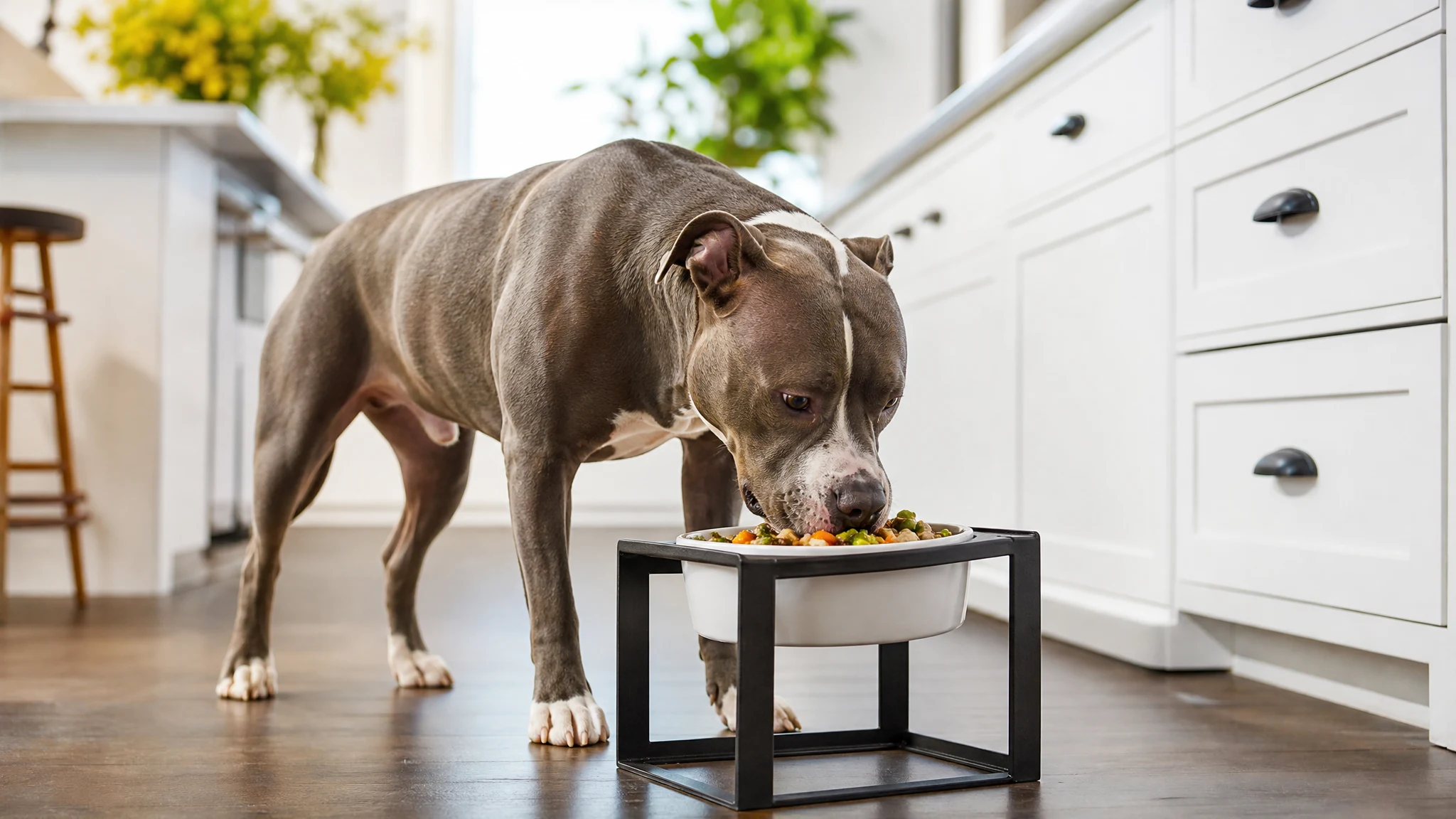
Many dogs eat fine from a bowl on the floor. Raised stands are sold widely, but do not assume taller is better. Questions about stand height and bloat or joint comfort are medical ones, and the answer can differ by dog. Ask your veterinarian before buying a raised feeder, especially if your dog has had digestive or mobility concerns.
Step 5: Set up your measuring routine
Keep the scoop or scale right at the station. Measuring every meal, rather than guessing, is one of the most useful habits you can build. A heaping "eyeball" scoop can easily run well over the label amount, and the extra calories add up.
Weigh or measure the food, then pour it into the bowl. Write down anything extra, such as treats or toppers.
Step 6: Use the label as a starting point
Food labels give feeding guides, and they are starting points, not rules. The amount that suits your dog depends on weight, age, and activity level.
Here are examples from the brands' own pages, so you can see how much label guides vary:
- Hill's Science Diet Adult Large Breed Chicken & Barley lists 365 kcal per cup, and its feeding chart shows 3 1/4 cups per day for a 50 lb dog.
- Royal Canin Large Adult lists 360 kcal per cup. For a 57 lb dog at moderate activity, its guide shows about 3 3/8 cups (318 g).
- Royal Canin Medium Adult lists 340 kcal per cup, and is labeled for adult dogs 12 months and older, 23 to 55 lb.
Notice that calories per cup differ between foods. A switch from one food to another changes how much a cup delivers, so re-check the label guide each time. Hill's also says to adjust amounts as needed to maintain an optimal weight.
For a breakdown by age and weight, see our guide on how much to feed a Pit Bull by age and weight.
Step 7: Set a schedule and stick to it
Feed at consistent times in the same spot. Royal Canin UK gives about 12 months as the general guidance for moving medium-sized breeds from puppy food to adult food, though no age specific to Pit Bulls was found. Your veterinarian can confirm the right timing for your dog.
Puppies usually eat more often than adults, and your vet can suggest how many meals per day suit your dog's age. Whatever the schedule, pick up uneaten food after a set time rather than leaving the bowl out all day. That also helps you see how much your dog really eats.
Step 8: Teach a calm mealtime routine
Ask your dog to sit, wait a moment, then release them to eat with a cheerful word. Reward calm behavior with the meal itself. This is reward-based and fits with the humane approach recommended by the American Veterinary Society of Animal Behavior.
Do not push your dog away from the bowl, grab at the food, or use physical corrections. Those methods can make food guarding worse. If your dog growls, stiffens, or snaps near the bowl, stop and contact a qualified, reward-based trainer or your veterinarian.
Choosing a slow feeder or puzzle bowl
If your dog gulps food, a slow-feeder insert or puzzle bowl may help stretch out mealtime. Pick one with no sharp edges or small pieces that could break off. Start with an easy design so your dog does not become frustrated, and supervise the first several meals.
Some dogs love these. Others get upset. Watch your dog's body language and drop the tool if it causes stress.
Matching the station to the food type
- Dry food: A wide bowl and a scoop or scale work well. Keep the bag sealed in a container.
- Wet or fresh food: Wash the bowl right after meals. Follow the brand's storage directions. For example, JustFoodForDogs says thawed sealed meals are used within 7 days and within 5 days once opened.
- Mixed feeding: Track total calories across everything you offer, not just one item.
For our comparisons, we looked at label data on brand pages. We did not run feeding trials or taste tests. Always check the current label on the bag or the brand's own page, since recipes and guides can change.
Common mistakes to avoid
- Free-feeding without measuring. It hides how much your dog eats and makes weight changes harder to catch. Hill's lists weight management among the diet-relevant concerns for this breed.
- Using a bowl that slides or tips. It can turn into a toy.
- Forgetting treats in the total. Treats and table scraps count toward daily intake.
- Switching foods overnight. Hill's suggests a 7-day transition, mixing increasing amounts of the new food with decreasing amounts of the old.
- Ignoring the life-stage statement. Check the AAFCO statement on the label. Some foods are labeled for adults only, while others cover all life stages. Hill's Science Diet Adult Large Breed, for instance, says it is not for large breed puppies.
- Assuming a bigger breed rule applies. Pit Bulls are medium, below the 70 lb AAFCO cutoff for large-size dogs. So a large-breed puppy formula is generally not needed. Some nutritionists use 50 lb as their cutoff, so a very big individual may be near it. Ask your vet.
- Using the station to "fix" a health issue. A bowl cannot treat allergies, joint problems, or digestive trouble. Hill's notes hip and elbow dysplasia and skin allergies as concerns for the breed, and a veterinarian decides what diet suits an individual dog.
Tips for a smooth routine
- Wipe the mat daily and wash it weekly.
- Keep the station away from the trash and from the dog's bed.
- Weigh your dog on a regular schedule and note it in your diary.
- Take your dog's food and water bowls along when you travel, so the routine stays familiar.
- Check bowls for scratches, cracks, or wear, and replace them when damaged.
What to expect
With a steady setup, many owners find that mealtimes become calmer and more predictable. Measuring may help you spot changes in appetite sooner, and a tidy station can cut down on mess. Results vary by dog, and a station is only one part of good care.
If your dog has a health condition, is underweight or overweight, or is a growing puppy, confirm amounts and the schedule with your veterinarian. Sudden changes in appetite, vomiting, or loose stools also call for a vet visit, not a new bowl.
Quick checklist
- Choose a quiet spot with a wipeable floor.
- Set out a stable food bowl and a separate water bowl on a mat.
- Keep a scale or measuring cup at the station.
- Start from the label guide and adjust with your vet's advice.
- Feed at set times and pick up leftovers.
- Use calm, reward-based routines.
- Wash everything regularly.
Sources
- United Kennel Club, American Pit Bull Terrier breed standard
- Hill's Pet Nutrition, American Pit Bull Terrier breed page
- Royal Canin UK, when to switch your puppy to an adult diet
- Royal Canin, Medium Adult
- Royal Canin, Large Adult
- Hill's Science Diet, Adult Large Breed
- Hill's Science Diet, Puppy Large Breed
- JustFoodForDogs, Beef & Russet Potato Recipe