Elevated vs Floor Feeding for Pit Bulls: Does It Matter?
General nutrition information compiled from product labels and published sources, not veterinary advice. Your veterinarian is the right person to choose a diet for your dog, especially one with a health condition.
Walk down any pet aisle and you will see raised bowl stands sold as a smarter way to feed. Then you will hear a friend say floor bowls are fine and always have been. Both can sound confident.
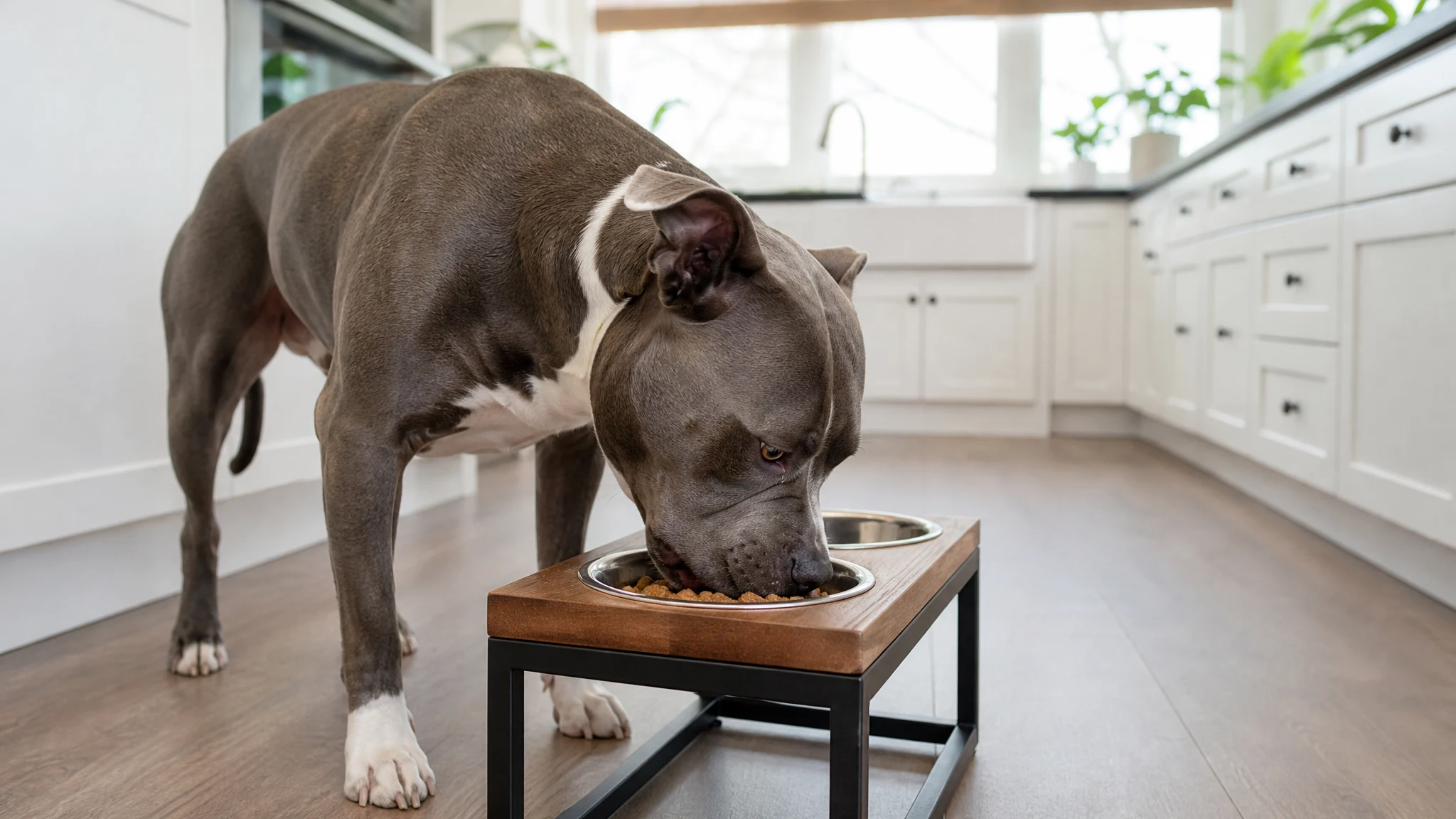
This guide helps you decide for your own Pit Bull. It covers how to set up a dog feeding station, how to test a height, and how to measure meals. It also covers what we cannot tell you, because the evidence on raised bowls is not something we can cite here.
What we can and cannot say about bowl height
Be wary of anyone who says raised feeding is always better or always worse. We did not run feeding trials or test any bowls ourselves. Our approach is to compare label data and published breed information, then tell you plainly where the answer is "ask your vet."
We do not have a source we can point to that settles whether bowl height changes health outcomes in dogs. So we will not claim a raised stand prevents any condition, and we will not claim floor feeding is safer. If you have heard bloat is tied to bowl height, bring that question to your veterinarian. They know your dog's history and can weigh it properly.
What we can do is help you set up a feeding spot that is comfortable, stable and easy to keep clean. That matters whichever height you choose.
Why the breed's size is a useful starting point
The United Kennel Club describes the American Pit Bull Terrier as a medium-sized dog. Its breed standard lists males at 18 to 21 inches and females at 17 to 20 inches at the withers. Weight runs 35 to 60 pounds for males and 30 to 50 pounds for females.
"Pit Bull" is a type, not a single registry breed. Your dog may be smaller, taller or heavier than those ranges. Measure your own dog instead of relying on an average.
Materials you need
- Two bowls, one for food and one for water. Stainless steel or ceramic are easy to wash.
- A non-slip mat or a bowl with a rubber base.
- A tape measure.
- Optional: an adjustable raised stand, or a sturdy box or step you can use to test heights before buying anything.
- A kitchen scale or a marked measuring cup for meals.
- Your dog's food label or feeding guide.
How to set up a dog feeding station, step by step
1. Measure your dog
Have your dog stand square on a flat floor. Measure from the floor to the point of the shoulder (the withers) and from the floor to the lower chest. Write both numbers down.
The UKC ranges above tell you what is typical for the breed. Your dog's own numbers are what count for bowl placement.
2. Choose a quiet, stable spot
Pick a low-traffic corner with a washable floor. Avoid doorways and the path between the kitchen and the door. A dog that is jostled or startled while eating may gulp or guard the bowl.
Put the mat down first and set the bowls on it. A bowl that slides across the floor makes mealtime messy and can frustrate a strong, eager eater.
3. Start with the floor as your baseline
Begin with the bowl on the mat. Watch a few meals. Notice how your dog stands, whether the neck looks strained, and how fast the food disappears.
This baseline helps you judge whether a change is needed. If your dog eats comfortably and calmly, you may have no reason to change anything.
4. Test a raised height only if you have a reason
Some owners consider a raised stand because of a stiff neck, age, or mobility trouble. If that is your situation, talk to your veterinarian first. Hill's Pet Nutrition lists hip and elbow dysplasia among the health topics for the breed, so joint comfort is a fair question to raise at a checkup.
To test a height cheaply, set the bowl on a sturdy box. A common rule of thumb is to place the rim around lower-chest height, so your dog does not have to reach up or crouch down. Treat that as a starting point, not a rule. Adjust it based on how your dog looks while eating.
5. Make sure the stand is stable
If you use a stand, push on it. It should not wobble, tip or slide. Pit Bulls are strong and often enthusiastic at mealtime, and a flimsy stand can tip over a full bowl.
Check that the bowl sits snugly in the ring and cannot be flipped out.
6. Measure the meal
Use a scale or a measuring cup every time. Scooping by eye drifts upward over the weeks.
Start from your food's own feeding guide, using your dog's current weight and activity level. Some examples of label guides:
- Royal Canin says its Large Adult dry food, made for dogs 56 to 100 pounds, works out to about 3 3/8 cups (318 g) a day for a 57 pound dog at moderate activity.
- Hill's says its Science Diet Adult Large Breed dry food chart lists 3 1/4 cups a day for a 50 pound dog, and tells owners to adjust to maintain optimal weight.
These are label starting points for particular products, not a prescription. Foods differ in calories. Royal Canin lists its Medium Adult at 340 kcal per cup and its Large Adult at 360 kcal per cup. Hill's lists its Adult Large Breed at 365 kcal per cup. Always follow the guide on the bag you actually buy. For a broader look by age and weight, see our Pit Bull feeding chart by age and weight.
7. Pick a schedule and stay consistent
Divide the daily amount into set meals, and feed at about the same times each day. Puppies are usually fed more often than adults, and your vet can suggest a schedule. Royal Canin UK notes that medium breeds are generally ready to switch to an adult diet at about 12 months, though no Pit Bull specific age was found. Ask your vet when your dog should switch.
If you change foods, Hill's suggests a 7 day transition. Mix increasing amounts of the new food with decreasing amounts of the old.
8. Keep the station clean
Wash the food bowl after meals and the water bowl daily. Wipe the mat and the floor around it. Fresh and wet foods spoil faster than dry food. JustFoodForDogs, for example, says its thawed sealed meals should be used within 7 days and within 5 days once opened.
Tips for a calmer mealtime
- Keep other pets apart. Feed each animal in its own space so no one feels they have to defend a bowl.
- Use reward-based habits. Ask for a sit and a calm pause before the bowl goes down, and reward it. Do not use force, startling noises or physical corrections around food. The American Veterinary Society of Animal Behavior supports humane, reward-based methods.
- Slow a fast eater. A wide, shallow bowl or a slow-feeder insert can help. Ask your vet if gulping is a regular problem.
- Watch the whole picture. Appetite, stool, coat and energy tell you more than the bowl does.
- Track body condition. Hill's lists weight management, with healthy weight and lean muscle, as a diet-related topic for the breed. Check your dog's waistline and ribs now and then and adjust portions with your vet.
Common mistakes to avoid
- Buying a stand before measuring. A stand that is too tall can be as awkward as one that is too low.
- Treating a raised bowl as a health fix. We cannot say it prevents or treats anything. It is a comfort and convenience choice that your vet can help you judge.
- Using a wobbly or lightweight setup. Strong dogs can tip it.
- Free-feeding without measuring. A full bowl left out all day makes it hard to know how much your dog eats.
- Ignoring the label. Some foods say they are for all life stages except growth of large size dogs (70 lb or more as an adult). Pit Bulls usually sit below that 70 pound mark, but ask your vet to confirm for your individual puppy.
- Switching foods and bowl height at the same time. Change one thing at a time so you can tell what made the difference.
What results to expect
If you set up a stable, quiet station and measure meals, you may notice tidier mealtimes, less spilling and a clearer picture of how much your dog eats. Some dogs seem more comfortable at a different height, while many do just fine on the floor.
A raised bowl may help some dogs with neck or joint discomfort feel more at ease, but results vary and we cannot promise any health benefit. Hill's gives 12 to 14 years as a typical life expectancy for the breed. Steady weight, regular checkups and a food that suits your dog matter far more over that span than the height of a bowl.
If your dog has a health condition, such as joint trouble, skin allergies or a weight problem, confirm amounts, food choice and bowl setup with your veterinarian. Prescription diets are something only a vet can prescribe.
Quick decision guide
| Situation | A reasonable next step |
|---|---|
| Healthy dog, eats calmly from the floor | Keep the floor setup on a non-slip mat |
| Dog seems stiff or uncomfortable while eating | Ask your vet, then test a modest raised height |
| Dog gulps food | Try a slow-feeder bowl and ask your vet |
| Worried about bloat or another condition | Ask your vet about your dog's specific risk |
| Unsure how much to feed | Start with the label guide, then adjust with your vet |
Sources
- United Kennel Club, American Pit Bull Terrier breed standard
- Hill's Pet Nutrition, American Pit Bull Terrier breed page
- Royal Canin UK, when to switch your puppy to an adult diet
- Royal Canin, Medium Adult dry dog food
- Royal Canin, Large Adult dry dog food
- Hill's Science Diet, Adult Large Breed dry dog food
- JustFoodForDogs, Beef & Russet Potato Recipe