Dog Feeding Chart for Pit Bulls: Puppy to Senior
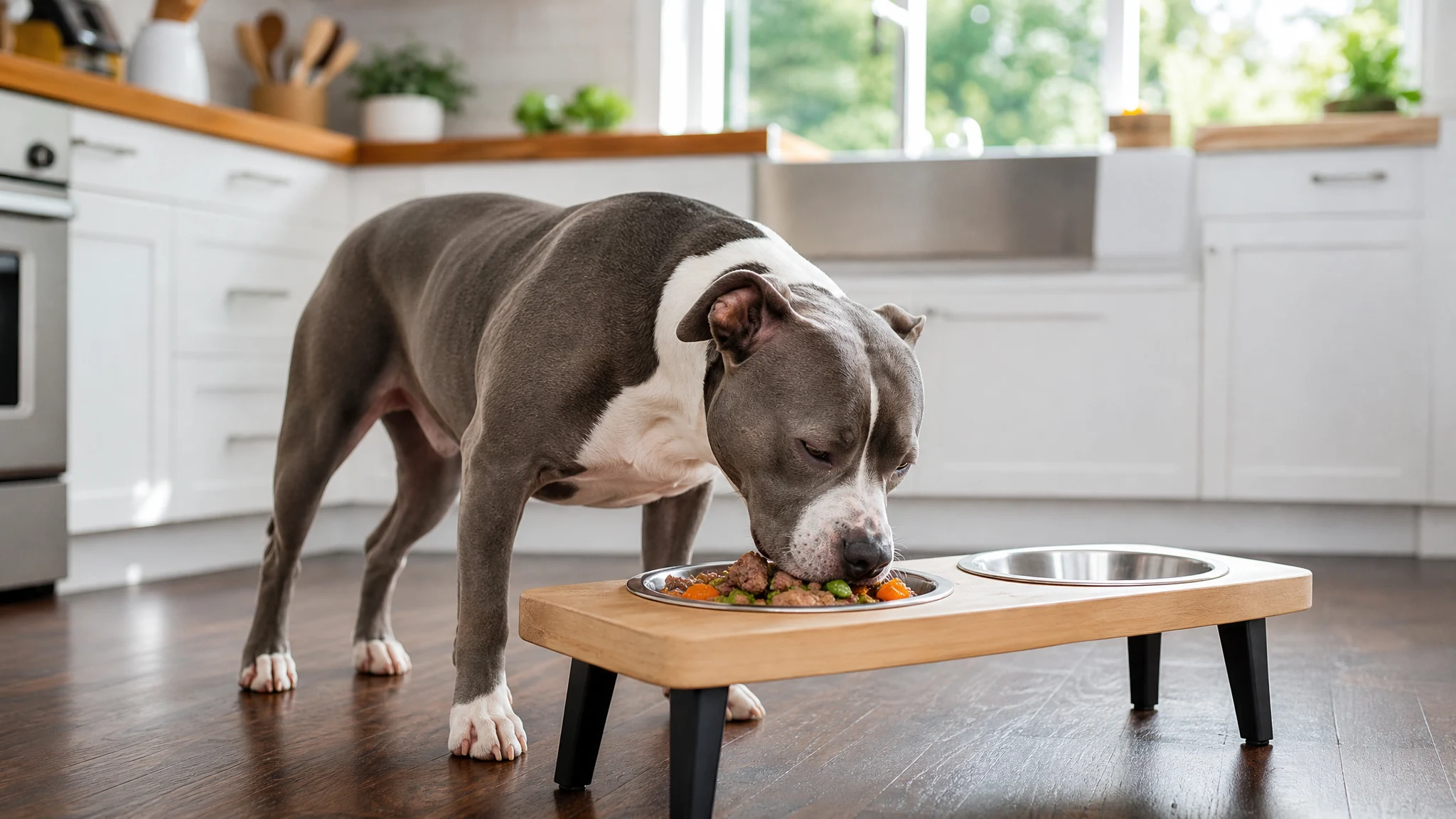
General nutrition information compiled from product labels and published sources, not veterinary advice. Your veterinarian is the right person to choose a diet for your dog, especially one with a health condition.
A dog feeding chart is only as good as the numbers you put into it. For a Pit Bull, those numbers are your dog's current weight, age and activity level, plus the calorie data printed on the food you pick.
This guide shows you how to build your own chart in a few steps. It does not hand you one fixed set of cups per day, because no label or breed source gives one for every Pit Bull. If you want a ready-made table to compare against, see our Pit Bull feeding chart by age and weight.
What You Need Before You Start
- A scale that can weigh your dog (a bathroom scale works if you weigh yourself holding the dog, then alone, and subtract).
- The bag, can or package of the food you plan to use, with its feeding guide and calorie statement.
- A measuring cup, or better, a kitchen scale for the food. Royal Canin's own page notes that grams are the most accurate form of measurement and cups are only close.
- A notebook or phone note to log weight, amounts and treats.
- Your veterinarian's contact, for the checks in step 7.
Know Your Dog's Size First
"Pit Bull" is a type, not a single registry breed. The United Kennel Club describes the American Pit Bull Terrier as a medium dog, with males at 35 to 60 lb and females at 30 to 50 lb. Hill's Pet Nutrition lists a range of 30 to 60 lb, with males heavier.
Many shelter and family dogs called Pit Bulls are mixes, so your dog may fall outside those ranges. Use your own dog's scale weight, not the breed average.
How We Compared Foods
We compared label data only: the AAFCO statement, ingredient order, guaranteed analysis and calories as published by each brand. We did not run feeding trials or taste tests, and nothing here says one food is best for every dog.
Step-by-Step: Build the Chart
1. Pick the life stage on the label
Look for the AAFCO statement. It tells you whether a food is for growth, adult maintenance, or all life stages. Foods differ here:
- Royal Canin Medium Adult states it meets AAFCO maintenance levels and is for dogs 12 months and older, 23 to 55 lb.
- Victor Hi-Pro Plus and High Energy are labeled for all life stages except growth of large size dogs (70 lb or more as an adult).
- Freshpet Vital Chicken and Nom Nom Beef Mash are labeled for all life stages, including growth of large size dogs.
- JustFoodForDogs Beef & Russet Potato is for adult maintenance and is not intended for growing puppies.
2. Decide whether your puppy needs a large-breed puppy food
AAFCO's large-size cutoff is 70 lb or more as an adult, and Pit Bulls generally fall below it. Whole Dog Journal notes that large-breed puppy diets cap calcium at 1.8% on a dry matter basis, versus 2.5% for other foods. It also says some nutritionists use 50 lb as the cutoff, so a very big Pit Bull could be near the line.
Ask your vet to confirm which puppy food fits your dog's expected adult size. Do not guess from the breed name alone.
3. Find the calories per cup
Calories tell you how much a cup of food really delivers. Here are the label figures from the brands:
| Food | Form | Calories on the label |
|---|---|---|
| Royal Canin Medium Adult | Dry | 340 kcal per cup |
| Royal Canin Large Adult | Dry | 360 kcal per cup |
| Hill's Science Diet Adult Large Breed Chicken & Barley | Dry | 365 kcal per cup |
| Hill's Science Diet Puppy Large Breed Chicken & Brown Rice | Dry | 387 kcal per cup |
| Victor Hi-Pro Plus | Dry | 406 kcal per cup |
| Victor High Energy | Dry | 412 kcal per cup |
| Nom Nom Beef Mash | Fresh | 201 kcal per cup |
The gap matters. A cup of Victor High Energy carries about 70 more calories than a cup of Royal Canin Medium Adult, so you cannot swap foods cup for cup. Hill's wet Adult Chicken & Barley lists calories per 13 oz can (369 kcal), not per cup. Freshpet and JustFoodForDogs publish per-kilogram or per-pack figures, so check their pages for the serving guide.
4. Start from the brand's feeding guide
Every brand's guide is a starting point, not a prescription. Two examples from the labels:
- Royal Canin Large Adult lists about 3 3/8 cups (318 g) a day for a 57 lb dog at moderate activity.
- Hill's Adult Large Breed lists 3 1/4 cups a day for a 50 lb dog.
Both are large-breed adult foods, shown here only to illustrate how a guide reads. Your dog's food will have its own chart. Find your dog's weight on that chart and note the amount. Nom Nom says its daily recommendations may vary with age, weight and activity level, and Hill's says to adjust amounts to maintain optimal weight.
5. Adjust for activity
Royal Canin's guide changes with activity level, and so should yours. A Pit Bull who runs, hikes or does sport work may need more than a couch-oriented companion. Move in small steps, and change one thing at a time so you can see what worked.
6. Set the chart by life stage
Use the table below as a framework. Fill in the amounts from your own food's label and your vet's advice.
| Stage | What the sources say | What to do |
|---|---|---|
| Puppy (to about 12 months) | Royal Canin UK gives about 12 months as general guidance for switching medium breeds to adult food. No Pit Bull specific age was found. | Feed a growth or all-life-stages food. Weigh often and ask your vet when to switch. |
| Adult | Hill's lists weight management and lean muscle as diet-relevant for the breed. | Use the adult label guide for your dog's weight, then adjust by body condition. |
| Senior | Hill's lists a life expectancy of 12 to 14 years. We found no Pit Bull specific senior start age or senior amounts. | Ask your vet when your dog counts as senior and whether the food or amount should change. |
Note that some labels set age limits. Hill's wet Adult Chicken & Barley is listed for ages 1 to 6 years and is not for mature adults, so an older dog needs a different label check.
7. Switch foods slowly and recheck
Hill's suggests a 7-day transition on its puppy food page: mix increasing amounts of the new food with decreasing amounts of the old. Weigh your dog every two to four weeks at first, then monthly. If weight drifts up or down, adjust the daily amount a little and recheck.
Tips That Help
- Measure by weight in grams when you can. Cups vary with how you scoop.
- Count treats and chews as part of the daily food, not on top of it.
- Read the first five ingredients and the AAFCO statement, not the front of the bag.
- Be skeptical of "Pit Bull formula" claims. We found no Pit Bull specific formula with label data to review.
- Write down your dog's food, amount and weight each month. The log makes vet visits easier.
Common Mistakes to Avoid
- Feeding by cup across brands. Calories per cup range widely, as the table shows.
- Using a large-breed puppy food without asking. Whole Dog Journal says the stricter calcium cap targets dogs expected to reach 70 lb or more. Your vet can confirm what fits.
- Using a food outside its label. Hill's Adult Large Breed is not recommended for large-breed puppies or pregnant or nursing dogs.
- Treating the guide as fixed. The brand's chart is a starting point only.
- Skipping the vet for health concerns. Hill's lists hip and elbow dysplasia and skin allergies (itchy skin, ear infections) as diet-relevant for the breed. Food does not treat or cure either one, and a veterinarian decides what suits an individual dog. Prescription diets come only from a veterinarian.
What to Expect
If the amounts suit your dog, you may see steady weight, a visible waist and ribs you can feel under a light layer of padding. Stools may become more consistent, and energy may be steady through the day. Results vary with age, health, activity and the food itself, and a chart cannot promise any outcome.
If your dog has a health condition, is pregnant or nursing, is losing or gaining weight quickly, or is a very large individual near the 70 lb mark, confirm amounts with your veterinarian before you settle on a chart. For meal frequency, no source we reviewed gives a Pit Bull specific schedule, so ask your vet and follow your food's label.
Sources
- United Kennel Club, American Pit Bull Terrier breed standard
- Hill's Pet Nutrition, American Pit Bull Terrier breed page
- Royal Canin UK, when to switch your puppy to an adult diet
- Whole Dog Journal, best large breed puppy food
- Dog Food Advisor, large breed puppy food and all life stages labels
- Royal Canin Medium Adult and Large Adult
- Hill's Science Diet Adult Large Breed, Puppy Large Breed and Adult Chicken & Barley canned
- Victor Hi-Pro Plus and High Energy
- Freshpet Vital Chicken Recipe
- Nom Nom Beef Mash
- JustFoodForDogs Beef & Russet Potato Recipe