Best Training Treats for Pit Bulls (and How Many to Give)
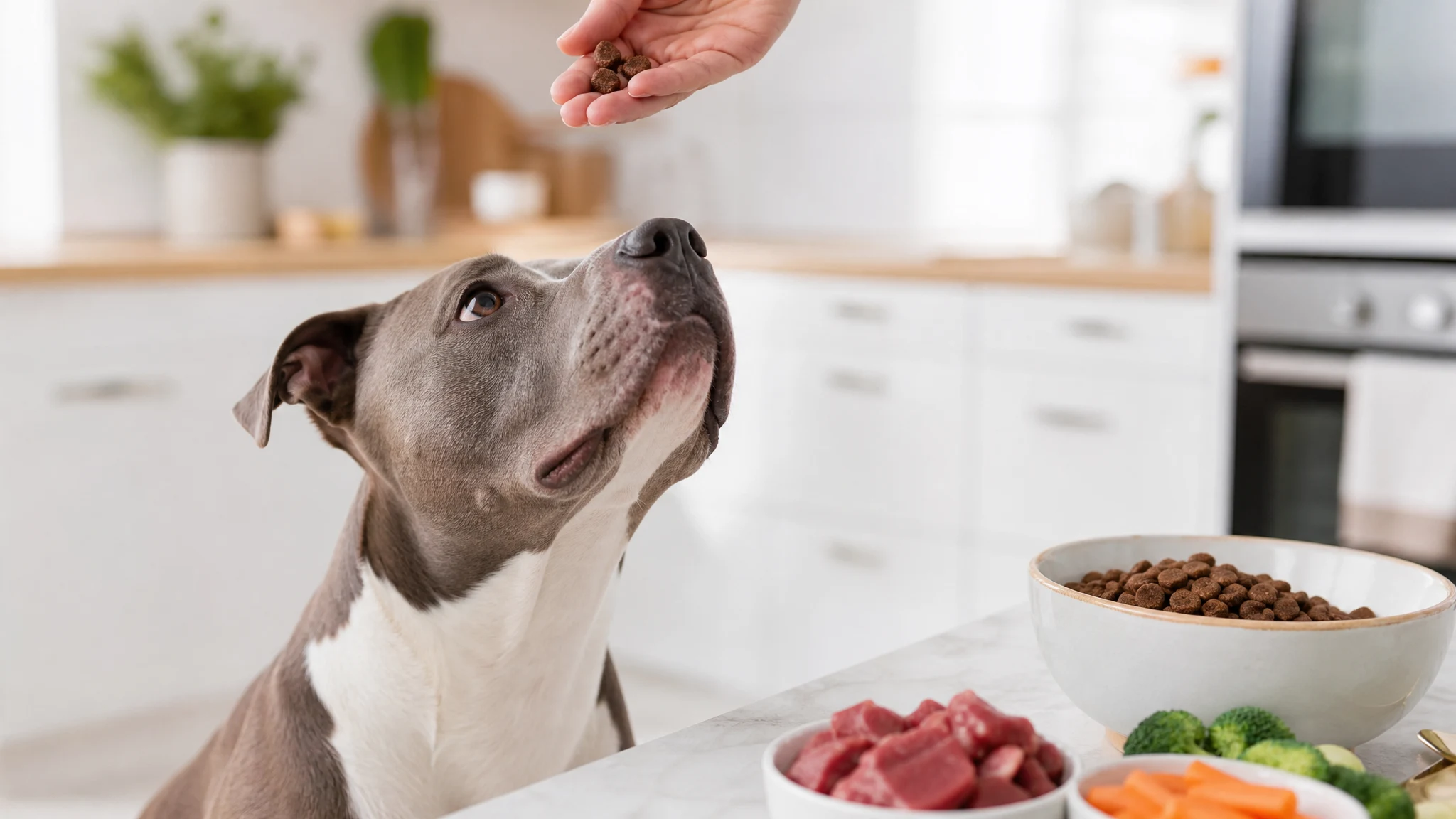
General nutrition information compiled from product labels and published sources, not veterinary advice. Your veterinarian is the right person to choose a diet for your dog, especially one with a health condition.
Training treats are small, so it is easy to forget they count as food. For a medium, muscular dog that often works hard for a reward, they can add up fast. This guide walks through how to pick the best treats for Pit Bulls, how to size them, and how to keep the daily total in check.
One note on terms. The United Kennel Club registers the American Pit Bull Terrier, and says males run about 35 to 60 lb and females about 30 to 50 lb. "Pit Bull" is also used as a broader type, so your dog may fall outside those ranges. Everything below applies to any dog of that general build, and your veterinarian knows your individual dog best.
How we approached this
We did not feed, taste-test or run trials with any treats. This is a label-reading guide. It explains what to look for on a package and how to do the math. Because we have no verified label data for specific treat products, we describe categories and do not name or rate individual treats. Check each brand's own page and the package for ingredients and calories.
Materials you will need
- Two or three types of treat from different categories (see Step 2).
- A small treat pouch or bowl that stays within reach.
- A kitchen scale or measuring spoon, to keep portions consistent.
- The calorie information from your dog's main food bag.
- A knife or treat scissors for cutting treats down.
- A notepad or phone note to log how many treats go in each day.
Step 1: Work out your dog's daily calorie budget
Start with the main food, because the treats come out of the same daily total. Look at the feeding guide on your dog's food. The label guide is a starting point, not a rule. Your veterinarian can tell you the right daily amount for your dog's age, weight and activity.
Food labels give calories in different ways. For example, Royal Canin lists its Medium Adult dry food at 340 kcal per cup, as fed. Hill's Science Diet lists its Adult Large Breed dry food at 365 kcal per cup. Wet and fresh foods are often listed per can, per pack or per kilogram, so read the unit before you compare. Our label-data comparison of foods for Pit Bulls shows how those figures differ from brand to brand.
Once you know the daily calorie number your vet recommends, you have your budget.
Step 2: Understand the 10 percent rule
The World Small Animal Veterinary Association (WSAVA) nutrition guidance suggests that treats should make up no more than about 10 percent of a dog's daily calories. The other 90 percent should come from a complete and balanced diet.
Here is a simple example of the arithmetic. These numbers are only an illustration, not a recommendation for your dog. If your vet says a dog needs 1,000 kcal a day, then treats should stay near 100 kcal, and the meals should supply about 900 kcal.
The treat share is a ceiling, not a target. A dog that is gaining weight may need less. Weight management is one of the diet-related topics Hill's Pet Nutrition lists on its American Pit Bull Terrier breed page, so it is worth watching your dog's body condition with your vet.
Step 3: Choose treat categories
The best treats for Pit Bulls are the ones your dog is excited about, that are small and low in calories, and that you can use without upsetting the rest of the diet. These three categories cover most training needs.
Soft training treats
These are small, moist and easy to break apart. They are quick to swallow, which keeps a training session moving. Many are made to be torn into tiny pieces. Check the calories per treat on the package, because some are higher than you would guess for their size.
Freeze-dried single protein treats
These contain one meat, which makes the ingredient list short and easy to read. They are light, strongly scented and useful for harder jobs, such as training around distractions. Single-protein is a helpful label to look for if your vet has asked you to keep ingredients simple. We do not claim it helps with any health condition. Skin allergies are listed on the Hill's breed page as a diet-related concern for the breed, and a veterinarian is the one to sort out what is behind itchy skin or ear trouble.
Vegetables
Some dogs will work for crunchy pieces of carrot or green bean. These are usually lower in calories than commercial treats, so they suit practice sessions with lots of repetition. Not every vegetable is safe for dogs, so ask your veterinarian before you add a new one, and introduce it in a small amount.
Step 4: Read the treat label
Be a little skeptical of the front of the package. Words like "premium" or "natural" tell you little. The back of the package is where the useful details are.
- Calories per treat. Look for a kcal-per-treat or kcal-per-kilogram figure. If it is missing, check the brand's own website or contact the company.
- Ingredient list. Ingredients appear in order by weight. A short list is easier to compare.
- Treat or complete food. Most treats say they are for intermittent or supplemental feeding. That means they are not a meal.
- Size and texture. Pieces should be easy to shrink without crumbling into dust.
Step 5: Size the treat for a Pit Bull
A Pit Bull is a medium dog, and the UKC puts the breed in the medium size category. That does not mean the treat should be medium. For training, think pea-sized or smaller.
A smaller piece does three things. It lets your dog finish chewing quickly and look back at you. It keeps calories low, so you can reward often. It also means more repetitions per session without adding up to a full meal.
Cut a large soft treat into several pieces. Break freeze-dried pieces apart with your fingers. If your dog is on the lighter end of the breed range, go smaller still. We do not have a verified standard size for treats, so use your dog's actual weight and your vet's advice as the guide.
Step 6: Count the treats
- Find the kcal per treat on the package, or estimate it after you cut a treat into pieces (divide the calories per full treat by the number of pieces).
- Take your daily treat budget, about 10 percent of the day's calories.
- Divide the budget by the calories per piece. That is your maximum number of pieces per day.
- Put that many pieces in a container each morning. When the container is empty, treats are done for the day.
If you use some of the daily kibble as training rewards, that is a good way to stay under budget. Just take it out of the bowl so the total does not rise.
Step 7: Use the treats well in training
Reward-based training is the approach recommended by the American Veterinary Society of Animal Behavior (AVSAB). Here is how treats fit.
- Reward right away. Give the treat within a second or two of the behavior you want, so your dog links the two.
- Use a higher-value treat for harder jobs. Practice at home with a soft treat or vegetable, and keep the freeze-dried meat for busy places.
- Mix up the rewards. Praise, a favorite toy or a short game can also work as a reward, and they cost no calories.
- Keep sessions short. A few minutes at a time is usually enough, and you will see fewer treats eaten per session.
Tips
- Introduce one new treat at a time, so you can tell what an upset stomach came from.
- Keep treats from the same category in the same container so you can count quickly.
- If you change your dog's main food, review the treat budget again, because the calories per cup will differ.
- For a puppy, ask your vet about treat size and quantity. Pit Bulls are generally considered adults at about 12 months, based on general guidance for medium breeds from Royal Canin UK, and no breed-specific age was found. Puppies are still growing, and their needs are different.
- Fresh and wet foods can be used as high-value rewards, but they also count toward the daily total.
Common mistakes to avoid
- Not counting treats. Several handfuls over a day can quietly pass the 10 percent mark.
- Using treats that are too big. One large biscuit can be the whole budget.
- Relying on one high-calorie treat. Mix in vegetables and a share of the regular kibble.
- Ignoring the rest of the family. Everyone who gives treats needs to know the daily limit.
- Using treats to fix a medical issue. No treat prevents or treats a condition such as hip and elbow dysplasia or allergies. These are things for your veterinarian to manage.
- Skipping the label. Two treats of the same size can have very different calories.
What results to expect
With small, well-timed rewards, many owners find that their dogs stay interested for longer and learn cues more steadily. Results vary with the dog's age, history and the setting, and nothing is guaranteed.
Keeping treats to a modest share of daily calories may help you hold a steadier body weight, which supports your efforts at healthy weight and lean muscle. Hill's lists these among the breed's diet-related topics. Your vet can check your dog's body condition and tell you whether the plan is working.
If your dog has loose stools, itching, or loses interest in meals after a treat change, pause the new treat and talk to your vet.
Quick checklist
- Know your dog's daily calorie target from your vet.
- Cap treats at about 10 percent of that number.
- Cut treats to pea size or smaller.
- Choose from soft, freeze-dried single-protein and vegetable options.
- Count pieces each morning.
- Reward with praise and play as well.
For help choosing the main diet that those treats sit alongside, see our comparison of foods by label data.