Wet vs Dry vs Fresh Food for Pit Bulls
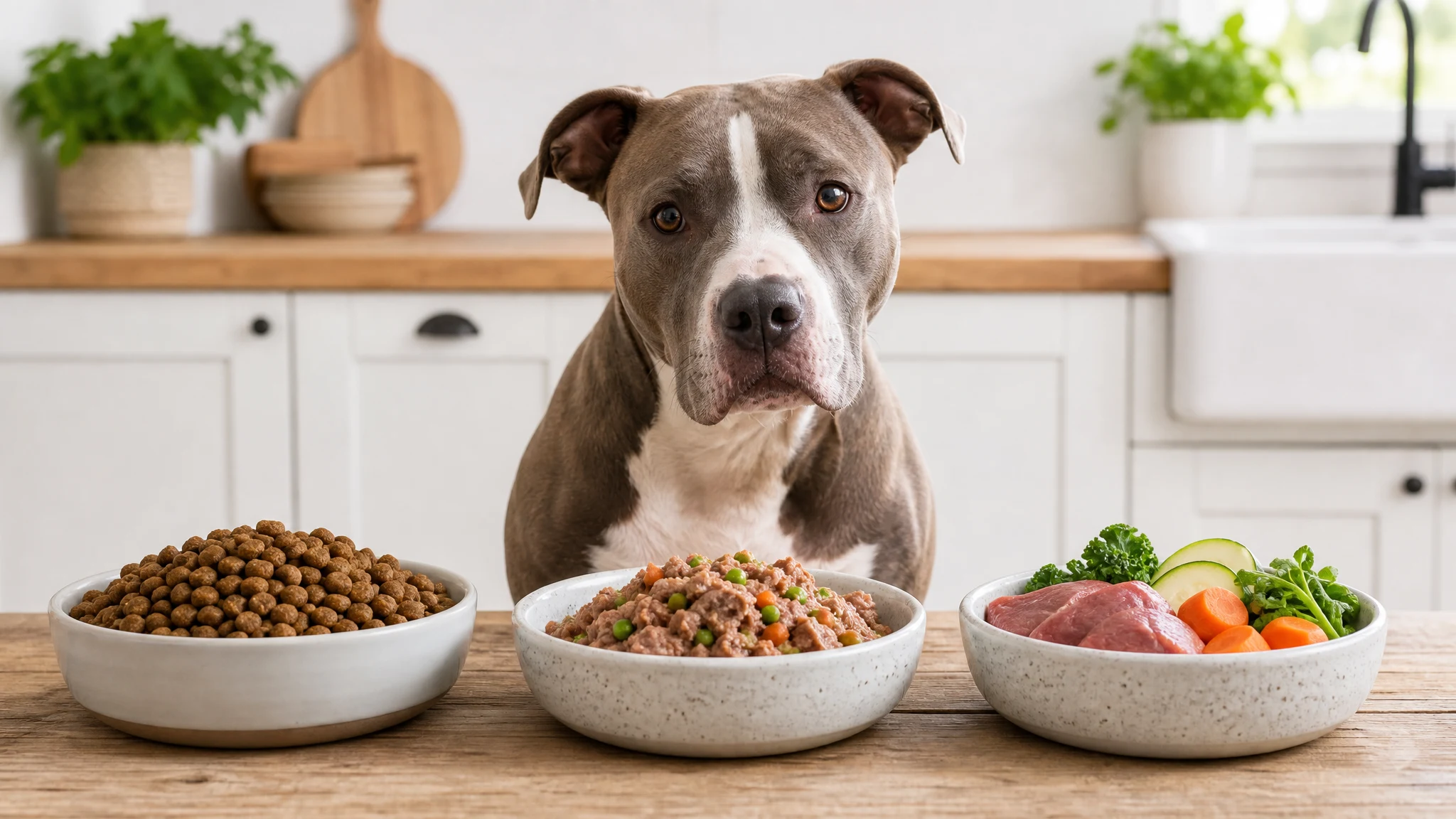
General nutrition information compiled from product labels and published sources, not veterinary advice. Your veterinarian is the right person to choose a diet for your dog, especially one with a health condition.
Walk down the dog food aisle and you will see three formats: dry kibble, canned wet food, and refrigerated or frozen fresh food. Each one claims to be the smart choice. For a Pit Bull owner, the honest question is simpler: what actually differs between them on the label, and which differences matter for a muscular, medium-sized dog?
This page is a wet vs dry dog food comparison with fresh added in. It looks at moisture, calories per serving, cost in general terms, dental myths and mixing. It is also a practical look at wet food for Pit Bulls and fresh dog food for Pit Bulls, without hype.
How this comparison was done
We compared label data published by the brands: the AAFCO nutritional adequacy statement, the first five ingredients, guaranteed analysis and calories. We did not run feeding trials or taste tests, and we have not fed these foods to dogs ourselves. Where a brand page does not publish a figure, we say so instead of guessing.
The products used as examples are Royal Canin Medium Adult and Large Adult (dry), Hill's Science Diet Adult Large Breed (dry), Victor Hi-Pro Plus and High Energy (dry), Hill's Science Diet Adult Chicken & Barley Entree (wet), and Freshpet Vital Chicken Recipe, Nom Nom Beef Mash and JustFoodForDogs Beef & Russet Potato (fresh). For a wider look at individual products, see our label-data comparison of foods for Pit Bulls.
First, what size dog are we feeding?
"Pit Bull" is a type, not a single registry breed. The United Kennel Club's breed standard for the American Pit Bull Terrier lists adult males at 35 to 60 lb and females at 30 to 50 lb, and calls the breed medium in size. Hill's Pet Nutrition's breed page gives a similar 30 to 60 lb range and a life expectancy of 12 to 14 years.
That matters for choosing a format because portion size and calorie density interact. A 45 lb dog eating a very calorie-dense food needs a small portion, and a small portion is easy to overfeed by a few extra scoops. Hill's lists weight management, including lean muscle, among the diet-relevant topics for the breed. Whether your own dog needs to gain, lose or hold weight is a question for your veterinarian.
The comparison table
| Attribute | Dry | Wet (canned) | Fresh |
|---|---|---|---|
| Moisture | Low. Dry matter is most of what is in the bowl. | High. Hill's lists water as the first ingredient of its canned entree. | High. Freshpet and Nom Nom list meat and vegetables first, with broth or eggs among the top five. |
| Calories per serving (from brand pages) | 340 to 412 kcal per cup across the five dry foods listed here | Hill's Adult Chicken & Barley Entree: 369 kcal per 13 oz can | Nom Nom Beef Mash: 201 kcal per cup. Freshpet: 309 kcal per 1/2 lb. JustFoodForDogs: 44 kcal per oz. |
| Cost per day, in general terms | Usually the lowest of the three | Usually higher than dry for a dog this size | Usually the highest |
| Storage | Sealed bag, shelf stable | Shelf stable until opened | Refrigerated or frozen. JustFoodForDogs says to use thawed sealed meals within 7 days, or 5 days once opened. |
| Kibble size | Not published on the pages we read | Not applicable | Not applicable |
| Life stage coverage | Varies by product | The Hill's example is for adults only | Varies. Freshpet and Nom Nom cover all life stages. |
Moisture: what it changes and what it does not
Moisture is the biggest practical difference. Wet and fresh foods are mostly water, so the same weight of food delivers fewer calories and less protein than dry food does. That is why the as-fed numbers on a fresh food label look low. Freshpet lists a minimum of 9.5% protein, Nom Nom 8.0% and JustFoodForDogs 8.5%, while Victor Hi-Pro Plus lists 30.0% and Royal Canin Medium Adult lists 23.0%.
You cannot compare those numbers straight across. Guaranteed analysis is usually printed as fed, so a wetter food looks lower in protein even if the recipe is rich in meat. To compare fairly you would need each food's moisture percentage and a dry matter conversion. The pages we read did not give moisture percentages for every product, so ask the brand or your veterinarian if you want that math done.
Hill's gives dry matter averages for its own foods, for example 26.7% protein for the canned entree. It notes that these are averages and not guaranteed minimums, so treat them as a rough guide only.
Calories per serving
Calorie density is where Pit Bull owners can run into trouble, because the units differ. Dry food is listed per cup, canned food per can, and fresh food per cup, per ounce or per half pound, depending on the brand.
- Royal Canin Medium Adult: 340 kcal per cup. Royal Canin Large Adult: 360 kcal per cup.
- Hill's Science Diet Adult Large Breed: 365 kcal per cup.
- Victor Hi-Pro Plus: 406 kcal per cup. Victor High Energy: 412 kcal per cup.
- Hill's canned entree: 369 kcal per 13 oz can.
- Nom Nom Beef Mash: 201 kcal per cup.
- Freshpet Vital Chicken: 309 kcal per 1/2 lb, calculated. No per-cup figure was given.
- JustFoodForDogs Beef & Russet Potato: 792 kcal per 18 oz pack, about 44 kcal per ounce.
Notice how much the dry foods differ from each other. Victor's two formulas are more calorie dense than the Royal Canin and Hill's adult formulas, and their first ingredients and fat minimums (20.0% for both) reflect a higher-energy design. A scoop of a high-energy kibble can be noticeably more food than the same scoop of a lighter one. Brands publish feeding charts, which are starting points. Hill's, for example, says to adjust amounts to maintain optimal weight, and its chart lists 3 1/4 cups a day for a 50 lb dog on the large breed adult food. Your dog's body condition and your veterinarian's advice should drive the real portion.
Dry food: pros and cons
Pros
- Generally the most budget friendly of the three formats per day of feeding, in broad terms.
- Easy to store, measure and carry. It is simple to use in puzzle feeders and training treats.
- A wide range of formulas, including medium breed, large breed and all life stages options.
Cons
- Calorie dense, so small measuring errors add up for a 35 to 60 lb dog.
- Low moisture, which matters if your dog drinks little.
- Kibble size is rarely published. The brand pages we read did not list dimensions, and Royal Canin says only that its large formula is designed for large jaws. If your dog has a small or short muzzle, ask the brand directly.
Wet food: pros and cons
Pros
- High moisture and strong aroma, which can help with picky or low-appetite dogs. That is a general observation, not a finding about the breed.
- Softer texture, which some owners prefer for older dogs or dogs with sensitive mouths.
- Shelf stable until opened. Hill's canned entree carries an AAFCO feeding-test statement for adult maintenance.
Cons
- Cans are heavy for the calories they hold, so feeding wet food alone to a Pit Bull usually costs more per day than dry. Check the brand's own pricing.
- Opened cans need refrigeration and have to be used promptly.
- The Hill's example is not for puppies, pregnant or nursing dogs, or mature adults, so one can does not suit every life stage.
If you are weighing wet food for Pit Bulls, check the life stage statement first. It tells you more than the front of the can does.
Fresh food: pros and cons
Pros
- Short, recognizable ingredient lists. Freshpet lists chicken, chicken liver, peas, carrots and broth. Nom Nom lists ground beef, russet potatoes, eggs, carrots and peas.
- Some recipes cover all life stages including growth of large size dogs, which is useful in a house with a puppy and an adult. Freshpet and Nom Nom both carry that statement.
- High moisture and a soft texture.
Cons
- Usually the highest cost per day for a dog in the 30 to 60 lb range, because you are paying for water, refrigeration and shipping or cold storage. Check each brand for current pricing.
- Needs fridge or freezer space and has a short use window once thawed or opened.
- Not all fresh foods fit every dog. JustFoodForDogs' beef recipe is for adult maintenance and is not intended for growing puppies.
- Per-cup calories are not always published. Freshpet and JustFoodForDogs give weight-based figures, so portions are usually set by package guides or the brand's feeding calculator.
When you look into fresh dog food for Pit Bulls, check the AAFCO statement as carefully as the ingredient list. "Fresh" describes the format, not the nutritional adequacy.
Dental myths
A common claim is that dry food cleans teeth and wet food ruins them. The product pages we read make no such claim, and the label data above includes nothing on dental outcomes. Treat the idea with caution. Kibble texture varies by product, and a food format does not replace tooth care. If dental health is a concern, a veterinarian can examine your dog's mouth and recommend a plan.
Mixing formats
Many owners combine formats, for example kibble with a spoonful of wet or fresh food on top. This can work, but a few cautions apply.
- Count the calories from both. A topper is not free. Use the per-can, per-cup or per-ounce figures above and reduce the kibble to match.
- Check that each food is complete and balanced for your dog's life stage. Mixing an adult-only food with a puppy food can leave a growing dog's diet unbalanced in ways that are hard to see.
- Switch gradually. Hill's recommends a 7 day transition when changing foods, mixing increasing amounts of new food with decreasing amounts of old.
A note on puppies and large-breed rules
AAFCO requires growth and all life stages foods to say whether they cover growth of large size dogs, meaning 70 lb or more as an adult, according to Dog Food Advisor's summary of the AAFCO label language. Large-breed growth foods have a stricter calcium maximum of 1.8% on a dry matter basis, versus 2.5% for other foods, per Whole Dog Journal.
Most Pit Bulls fall below the 70 lb mark, so the large-breed puppy rule generally does not apply. Whole Dog Journal notes that some nutritionists use 50 lb as a cutoff, so a very big individual could be close to it. Your veterinarian can confirm which puppy food fits. Victor Hi-Pro Plus and High Energy state that they are for all life stages except growth of large size dogs, which is worth remembering if your puppy might grow past that size.
Diet and breed health topics
Hill's lists hip and elbow dysplasia, skin allergies and weight management among the health topics it links to the breed. No food in this comparison prevents, treats or cures any of these. Diet is one factor among several, and a veterinarian decides what suits an individual dog. Prescription diets are something only a veterinarian prescribes.
Best for: recommendations by use case
- Everyday feeding on a steady budget: dry food. Pick a formula whose AAFCO statement matches your dog's life stage, and measure by weight if you can.
- A very active dog: a higher-calorie dry food such as the Victor formulas may fit, but watch body condition, because 406 to 412 kcal per cup leaves little room for error.
- A picky eater or an older dog with a sensitive mouth: wet or fresh food, or a small amount mixed into dry, with your veterinarian's input.
- A mixed-age household: an all life stages fresh food such as Freshpet or Nom Nom covers growth including large size dogs, but check portions for each dog.
- An owner who values short ingredient lists and has fridge space: fresh food, accepting the higher daily cost.
- A dog that needs weight control: any format can work if the calories are counted. Ask your veterinarian for a target and a feeding plan.
The verdict
There is no single winner, and the label data does not support naming one. Dry food is the practical default for most Pit Bull households because it is easy to portion and usually the cheapest to feed day to day. Its weak spots are calorie density and a lack of published kibble size.
Wet food is a sensible add-on or a choice for dogs that need softer, more aromatic meals, but as a sole diet it tends to cost more for a dog of this size. Fresh food has appealing ingredient lists and some all life stages options, but it asks the most of your budget and your fridge.
Whatever you choose, read the AAFCO statement, match it to your dog's life stage, count calories across everything in the bowl, and check body condition every few weeks. For anything about allergies, joints or weight, talk with your veterinarian before changing the diet. For product-by-product detail, see our label-data comparison.
Sources
- United Kennel Club, American Pit Bull Terrier breed standard
- Hill's Pet Nutrition, American Pit Bull Terrier breed page
- Whole Dog Journal, best large breed puppy food
- Dog Food Advisor, large breed puppy food and all life stages labels
- Royal Canin, Medium Adult
- Royal Canin, Large Adult
- Hill's Science Diet, Adult Large Breed
- Hill's Science Diet, Adult Chicken & Barley Entree
- Victor, Hi-Pro Plus
- Victor, High Energy
- Freshpet, Vital Chicken Recipe
- Nom Nom, Beef Mash
- JustFoodForDogs, Beef & Russet Potato Recipe