Best Puppy Food for Pit Bull Puppies
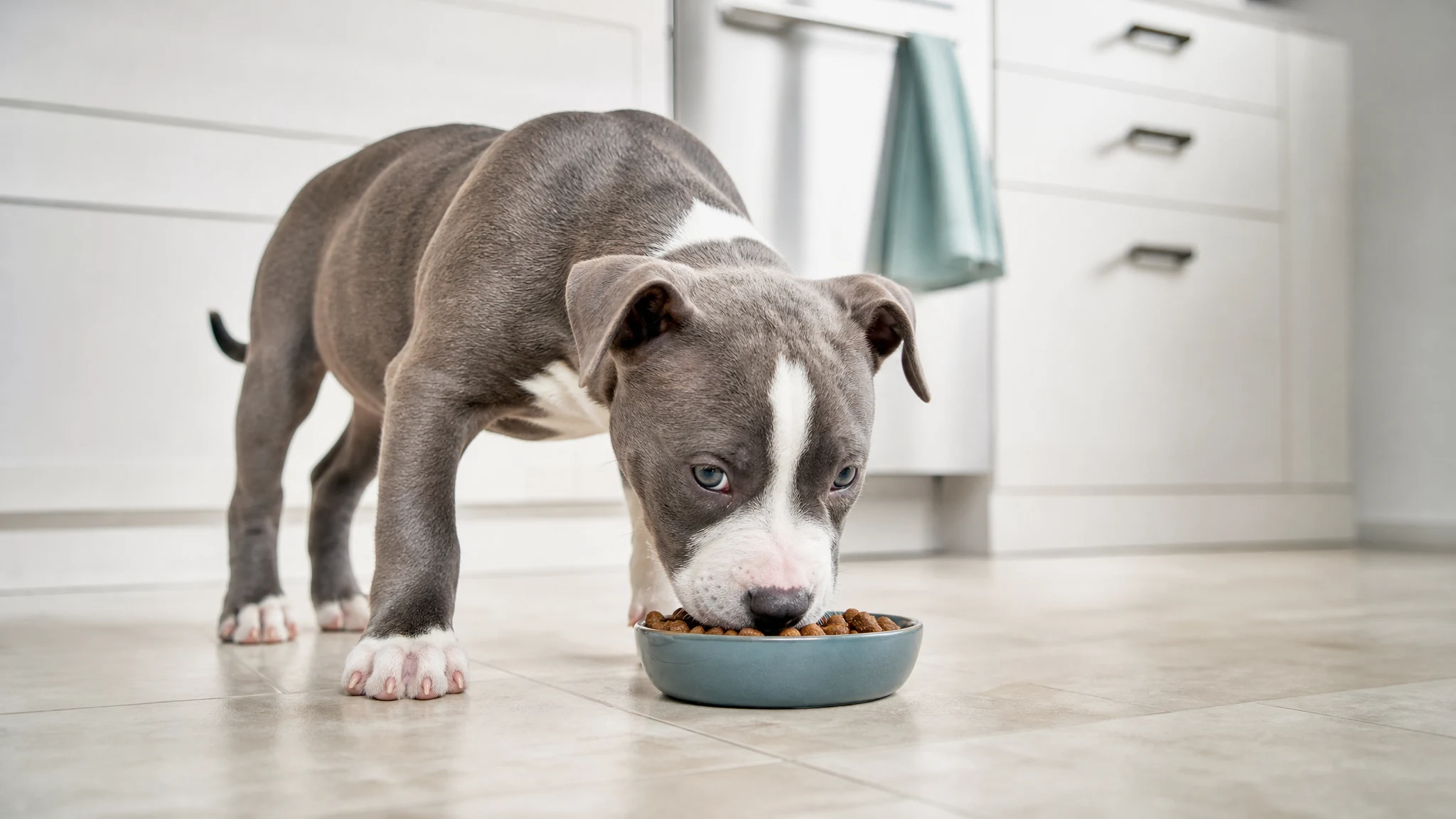
General nutrition information compiled from product labels and published sources, not veterinary advice. Your veterinarian is the right person to choose a diet for your dog, especially one with a health condition.
Shopping for pit bull puppy food is mostly an exercise in reading labels. Bags and boxes are covered in claims about muscle, strength and power. The part that matters is a small block of fine print that says whether the food is built for growing dogs at all.
This guide explains how to judge the best puppy food for pit bulls using label data. It covers what to look for, how to compare foods, a short list of foods whose labels cover growth, and the red flags that should send you back to the shelf.
How we compared these foods
We compared label data published by each brand: the AAFCO statement, the first five ingredients, the guaranteed analysis and the calories. We did not run feeding trials or taste tests, and we are not ranking foods by how well a puppy does on them. Every dog is different, and your veterinarian is the right person to decide what suits yours.
We only considered foods whose label statement covers growth. Adult-maintenance foods were left out on purpose, even good ones, because a puppy needs a food formulated for growth.
First, know what size your puppy will be
The United Kennel Club lists the American Pit Bull Terrier at 35 to 60 lb for males and 30 to 50 lb for females. Hill's Pet Nutrition gives a range of 30 to 60 lb, with males heavier. The UKC also classes the breed as medium sized. Note that "pit bull" is a type of dog, not a single registry breed, so individual dogs vary and mixed-breed pups can land outside these ranges.
This matters because of one line on pet food labels. AAFCO requires growth and all-life-stages foods to state whether they include or exclude growth of large size dogs, meaning dogs of 70 lb or more as adults (as quoted by Dog Food Advisor). Large-breed growth foods have a stricter calcium maximum, 1.8% on a dry matter basis, compared with 2.5% for other foods (Whole Dog Journal, a secondary source).
Most pit bulls finish below 70 lb, so a food that says "except for growth of large size dogs" is generally within its intended range. Whole Dog Journal notes that some nutritionists use 50 lb as the large-breed cutoff, so a very big individual may be near that line. If your puppy comes from big parents, ask your veterinarian which type of growth food fits.
What to look for on the label
1. An AAFCO statement that covers growth
This is the single most useful line on the package. Look for wording such as "for growth" or "for all life stages." A food labeled for "maintenance" or "adult" is not a puppy food, no matter how the front of the bag describes it.
Also check how the claim is supported. Some foods are "formulated to meet" the AAFCO nutrient profiles. Others state that animal feeding tests using AAFCO procedures substantiate the claim. Both are legitimate label statements, and they are different ways of backing the claim.
2. The large-size growth wording
Read whether the food includes or excludes growth of large size dogs. For a typical pit bull puppy, either statement can be reasonable, but you should know which one you are buying and why. See the size discussion above.
3. The first five ingredients
Ingredients are listed by weight before cooking, so the first few tell you the most. Look for a named animal protein near the top, such as chicken, beef or a named meal. Be aware that a fresh meat ingredient contains a lot of water, while a meal is concentrated, so the order alone does not rank protein quality.
4. The guaranteed analysis, read carefully
The guaranteed analysis lists minimum protein and fat and maximum fiber. Those are minimums and maximums, not averages. Some brands also publish dry matter averages on their web pages. Those are useful, but they are a different number and should not be compared directly with a guaranteed minimum.
Moisture matters too. A fresh or canned food will show lower percentages than a dry food simply because it contains more water. Comparing 9.5% protein on a fresh roll with 30% on a kibble bag tells you nothing without adjusting for moisture.
5. Calories per cup
Calorie density varies a lot between foods. A more calorie-dense food means a smaller portion, and a lighter food means a larger one. Calories per cup also let you compare the cost of feeding in practice, which is not the same as the price on the bag.
Key features to compare
Here is how the growth-appropriate foods in this guide compare on their published label data. Fresh foods list calories differently, so some cells are marked as not given.
| Food | Form | AAFCO growth coverage | Protein / fat | Calories |
|---|---|---|---|---|
| Victor Hi-Pro Plus | Dry | All life stages except growth of large size dogs (70 lb or more as an adult) | 30% min / 20% min | 406 kcal per cup |
| Victor High Energy | Dry | All life stages except growth of large size dogs | 24% min / 20% min | 412 kcal per cup |
| Hill's Science Diet Puppy Large Breed Chicken & Brown Rice | Dry | Growth, large breed puppies (over 55 lb as adults) | 26.7% / 15.4% (dry matter averages) | 387 kcal per cup |
| Freshpet Vital Chicken Recipe with Peas, Carrots & Brown Rice | Fresh | All life stages, including growth of large size dogs | 9.5% min / 7.0% min | No per-cup figure given |
| Nom Nom Beef Mash | Fresh | All life stages, including growth of large size dogs | 8.0% min / 5.0% min | 201 kcal per cup |
Kibble size is not published on any of these product pages, so we cannot say which is easiest for a small puppy mouth. Check with the brand if that matters to you.
Top picks by type of food
We do not have verified pricing for any of these foods, so we will not rank them by price. Prices change often and vary by size and by where you shop. Instead, the picks below are grouped by the kind of food, which is the main thing that drives cost. Fresh diets generally cost more to feed than dry, but check the brand's own page for current numbers.
Dry foods
Victor Hi-Pro Plus. Per the Victor product page, this dry food is formulated to meet the AAFCO Dog Food Nutrient Profiles for all life stages, except for growth of large size dogs (70 lb or more as an adult). The first five ingredients are beef meal, grain sorghum, chicken fat, whole grain millet and dried blood meal. Guaranteed minimums are 30% protein and 20% fat, with 3.8% fiber maximum, at 406 kcal per cup.
That is a rich, calorie-dense recipe. Portions will be small, and a puppy that gains too fast needs a conversation with your veterinarian rather than a bigger bowl.
Victor High Energy. The Victor High Energy page gives the same all-life-stages statement, with the same large-size exception. The first five ingredients are beef meal, grain sorghum, whole grain millet, chicken fat and chicken meal. Minimums are 24% protein and 20% fat, at 412 kcal per cup.
Both Victor foods are labeled for all breeds, with no pit bull specific formula. That is true of every food here.
Hill's Science Diet Puppy Large Breed Chicken & Brown Rice. According to the Hill's product page, animal feeding tests using AAFCO procedures substantiate that this food provides complete and balanced nutrition for growing puppies. It is intended for large breed puppies that will weigh over 55 lb as adults, and it is not recommended for adult dogs. The first five ingredients are chicken, brown rice, whole grain oats, chicken meal and cracked pearled barley. The page lists 387 kcal per cup.
Whether it fits depends on your puppy's expected size. With UKC adult weights up to 60 lb for males, it suits a bigger pup and may be more than a smaller female needs. Hill's does not publish guaranteed minimums for this food, only dry matter averages of 26.7% protein and 15.4% fat, so check the bag for the guaranteed analysis. Hill's advises transitioning over 7 days, mixing increasing amounts of the new food with decreasing amounts of the old.
Fresh foods
Freshpet Vital Chicken Recipe with Peas, Carrots & Brown Rice. The Freshpet page states it is formulated to meet AAFCO profiles for all life stages, including growth of large size dogs. The first five ingredients are chicken, chicken liver, peas, carrots and chicken broth. Minimums are 9.5% protein and 7.0% fat, with fiber at 1.5% maximum. These are fresh-roll numbers, so they include a lot of water. Freshpet does not give a per-cup calorie figure, and tells owners to use the on-package serving indicators.
Nom Nom Beef Mash. The Nom Nom page carries the same all-life-stages statement including growth of large size dogs. The first five ingredients are ground beef, russet potatoes, eggs, carrots and peas. Minimums are 8% protein and 5% fat, and the page lists 201 kcal per cup. Nom Nom describes its daily recommendations as only a guide that may vary with age, weight and activity.
Because the calorie density per cup is so different from kibble, never swap cups one for one when you move between dry and fresh foods.
Foods we left out
Several well-known foods carry adult or maintenance statements, including Royal Canin Medium Adult, Royal Canin Large Adult, the Hill's Science Diet adult recipes and the JustFoodForDogs Beef & Russet Potato recipe. JustFoodForDogs states that recipe is not intended for growing puppies. They may be fine foods for an adult pit bull, but they are not on this list because the label does not cover growth.
Red flags to avoid
- No AAFCO statement, or an adult-only one. A puppy food should say it is for growth or all life stages.
- Breed-power marketing. Words like "bully," "muscle building" or "pit bull formula" are marketing. We found no pit bull specific formula with published label data, so treat that wording with suspicion.
- Disease claims. A food that says it prevents or treats hip dysplasia, allergies or any other condition is making a claim a regular dog food cannot back. Hill's lists hip and elbow dysplasia and skin allergies among concerns for the breed, but what to feed an individual dog is a decision for a veterinarian. Prescription diets are only available through one.
- Missing information. If the brand will not tell you calories per cup or the full guaranteed analysis, that is a reason to look elsewhere.
- Feeding a large-breed puppy food by default. It is not automatically better. Match the food to your puppy's expected adult size, with your veterinarian's help.
- Extreme rich foods fed freely. Calorie-dense recipes are easy to overfeed. Follow the label and ask your vet about growth rate.
How to feed once you choose
Use the label as a starting point
Every brand publishes a feeding guide, and each one describes itself as a guide. Start there, then adjust to your puppy's body condition and your vet's advice. We have not listed cup amounts here because puppy feeding charts depend on age and expected adult weight, and the bag chart is the right source.
Feed several small meals
Puppies are usually fed their daily amount split across several meals rather than one large one. Your veterinarian can tell you how many meals fit your puppy's age, and when to reduce them as your dog grows.
When to switch to adult food
Royal Canin UK gives about 12 months as general guidance for switching medium-sized breeds to an adult diet. That is general guidance, not a pit bull specific age. Hill's large breed puppy formula runs up to 18 months, so the right timing depends on your puppy's size and food. Ask your veterinarian before you change, and make the switch gradually over about a week by mixing the old and new foods.
Where to buy
Start with the brand's own website. It will have the current label, ingredient list and feeding guide, and many brands list where their food is sold. Fresh brands such as Nom Nom sell through their own sites, while Freshpet's page and the others can tell you about stores that carry it. Availability and price differ by region, so check directly with each brand.
Before you buy, compare the label on the package in your hands with the brand page. Formulas change, and the bag is the official record. Buy a small bag first so that if your puppy does not take to the food, you have not committed to a large one.
The bottom line
The best food for a pit bull puppy is one whose label says it is for growth, matches your puppy's expected size, and gives you full numbers to compare. Among the foods with verified label data, the Victor dry foods, the Hill's large breed puppy recipe, Freshpet Vital and Nom Nom Beef Mash all have statements covering growth. Which one fits depends on your puppy's size, your budget and your veterinarian's advice.
Sources
- United Kennel Club, American Pit Bull Terrier breed standard
- Hill's Pet Nutrition, American Pit Bull Terrier breed page
- Whole Dog Journal, best large breed puppy food
- Dog Food Advisor, large breed puppy food and all life stages labels
- Royal Canin UK, when to switch your puppy to an adult diet
- Victor, Hi-Pro Plus
- Victor, High Energy
- Hill's Science Diet, Puppy Large Breed Chicken & Brown Rice
- Freshpet, Vital Chicken Recipe with Peas, Carrots & Brown Rice
- Nom Nom, Beef Mash