Best Food for Pit Bulls on a Budget
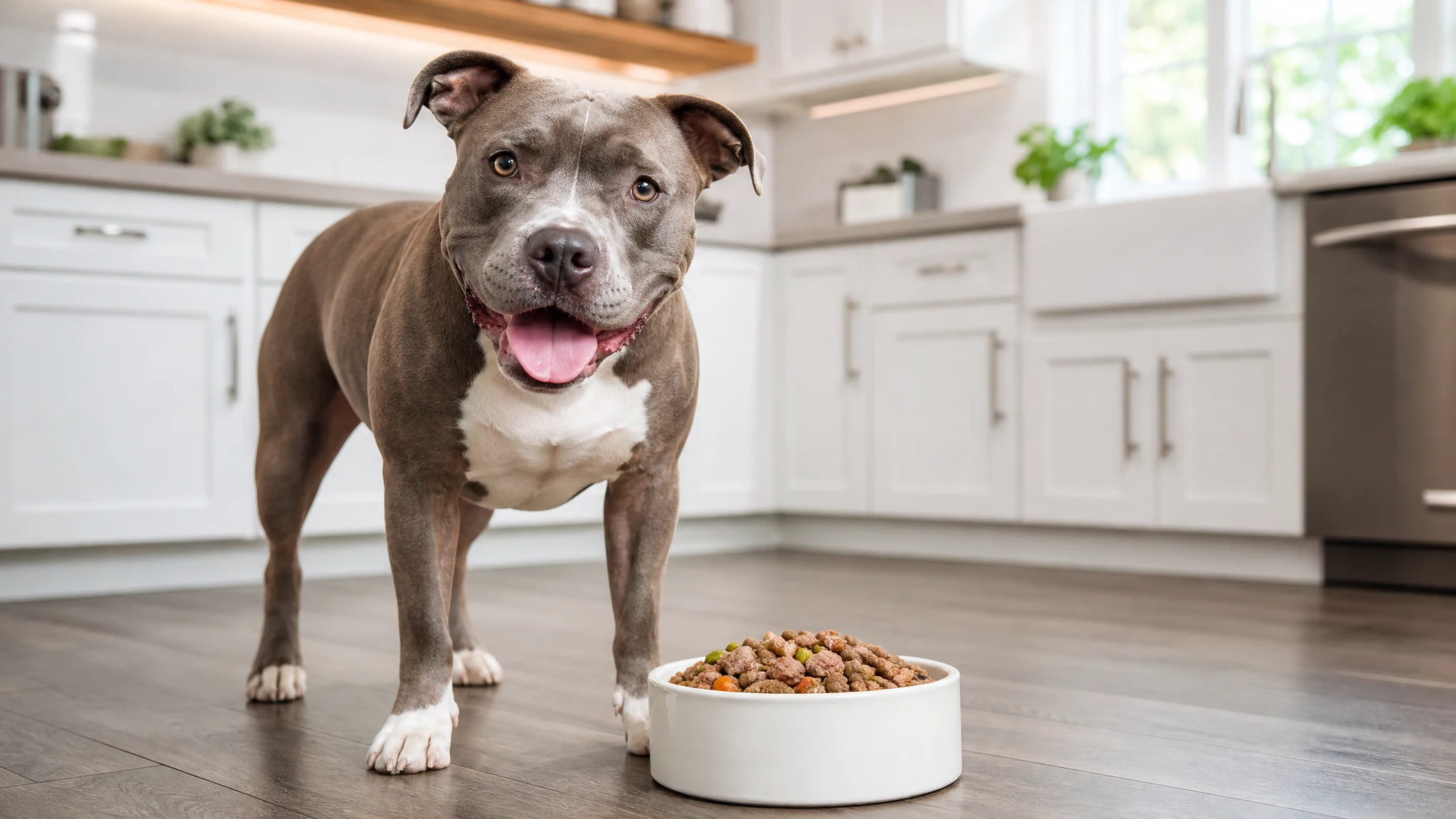
General nutrition information compiled from product labels and published sources, not veterinary advice. Your veterinarian is the right person to choose a diet for your dog, especially one with a health condition.
Feeding a Pit Bull well does not require the most expensive bag on the shelf. It requires reading the label, knowing your dog's life stage, and doing a little arithmetic. This guide walks through that process step by step.
One note on method. We compared label data from brand pages: AAFCO statements, life stage, protein, fat, calories and first ingredients. We did not run feeding trials or taste tests, and we have no price data to share. Prices change by store and week, so you will plug in your own.
Why "Pit Bull" Needs a Careful Definition First
The United Kennel Club recognizes the American Pit Bull Terrier. "Pit Bull" is a type, not a single registry breed, so your dog may be a mix. That matters because size drives food choice.
The UKC breed standard lists males at 35 to 60 lb and females at 30 to 50 lb. Hill's Pet Nutrition's breed page gives 30 to 60 lb. That makes the breed medium, not large.
No brand we checked makes a Pit Bull specific formula. A bag with a Pit Bull on it is marketing. A label that fits your dog's age and size is what counts.
Materials Needed
- Your dog's current weight from a home scale or a vet visit
- Your dog's age in months
- A phone calculator
- The brand page or bag label for each food you are considering (look for the AAFCO statement, guaranteed analysis and calories)
- The price and bag weight at the store you actually use
- A measuring cup, or better, a kitchen scale
Step 1: Match the Life Stage
Start with the AAFCO statement. It says whether the food is complete and balanced for growth, maintenance, or all life stages.
Royal Canin UK suggests that medium-sized breeds move to an adult diet at about 12 months. It did not give a Pit Bull specific age, so ask your vet about your own dog.
For puppies, look for "growth" or "all life stages" in the statement. An adult maintenance food, such as the Hill's Science Diet Adult Large Breed recipe, is not meant for puppies according to its brand page.
Step 2: Decide Whether You Need a Large-Breed Puppy Food
AAFCO defines "large size" as 70 lb or more as an adult. Dog Food Advisor, quoting AAFCO label language, notes that growth and all-life-stages foods must state whether they include or exclude growth of large dogs. Whole Dog Journal says the calcium maximum is 1.8% on a dry matter basis for large-breed growth, against 2.5% for other foods.
Most Pit Bulls finish under 70 lb, so the large-breed puppy rule generally does not apply. Whole Dog Journal also notes that some nutritionists use 50 lb as the cutoff, so a very big individual could be near it. Your vet should confirm.
This can save money. If your puppy is not headed for 70 lb, you are not forced into a large-breed puppy line. If your vet says your puppy is, check that the statement includes large-size growth.
Step 3: Read the Label Data
Here is what the brand pages say for several foods. These are label figures only. Protein and fat are guaranteed minimums unless noted.
| Food | Form | AAFCO life stage | Protein / fat | Calories | First ingredient |
|---|---|---|---|---|---|
| Royal Canin Medium Adult | Dry | Maintenance, 12 months and older, 23 to 55 lb | 23% / 12% min | 340 kcal per cup | Brewers rice |
| Royal Canin Large Adult | Dry | Maintenance, over 15 months, 56 to 100 lb | 24% / 15% min | 360 kcal per cup | Chicken by-product meal |
| Hill's Science Diet Adult Large Breed Chicken & Barley | Dry | Maintenance (feeding tests) | 23.8% / 15% (dry matter averages) | 365 kcal per cup | Chicken |
| Victor Hi-Pro Plus | Dry | All life stages except large-size growth | 30% / 20% min | 406 kcal per cup | Beef meal |
| Victor High Energy | Dry | All life stages except large-size growth | 24% / 20% min | 412 kcal per cup | Beef meal |
| Nom Nom Beef Mash | Fresh | All life stages, including large-size growth | 8% / 5% min | 201 kcal per cup | Ground beef |
Some notes on reading this table:
- Fresh foods hold a lot of water, so their protein and fat percentages look low. You cannot compare them directly with dry food. Compare calories instead.
- Hill's gives dry matter averages, not guaranteed minimums, so those two figures are not a like-for-like match with the others.
- Calories per cup range from 201 to 412 here. A cup of one food is not a cup of another.
- Kibble size was not listed on any of these brand pages.
For a wider side-by-side, see our Pit Bull dog foods compared by label data.
Step 4: Work Out the Real Daily Cost
The sticker price per bag tells you little. Cost per day is what matters, and it depends on calories.
- Find kcal per cup on the brand page. Some brands list kcal per kg instead. Hill's lists 3,675 kcal/kg for its adult large breed dry food, and Victor lists 3,815 kcal/kg for Hi-Pro Plus.
- Find how many cups or kilograms the bag holds. Multiply cups by kcal per cup, or kilograms by kcal per kg, to get total calories in the bag.
- Divide the bag price by total calories, then multiply by 1,000. This gives cost per 1,000 kcal.
- Find your dog's daily starting amount from the brand's feeding chart. Multiply that by the cost per 1,000 kcal to get a daily figure.
Brand charts are starting points, not prescriptions. Hill's chart shows 3 1/4 cups a day for a 50 lb dog on its adult large breed recipe. Royal Canin lists about 3 3/8 cups for a 57 lb dog at moderate activity on its Large Adult food. Both brands say to adjust to keep your dog at a healthy weight.
A more calorie-dense food can mean fewer cups per day. A cheaper bag that needs more cups may not be the cheaper food.
Step 5: Check the First Ingredients and the Brand's Own Page
Ingredients are listed by weight, but weight includes water. Chicken listed first can shrink after cooking, so a meal-based food may carry more protein by weight than its ingredient order suggests. Do not read too much into one ingredient slot.
Instead, check that the statement, life stage and calories fit your dog. Then confirm everything on the brand's own page, for example Royal Canin Medium Adult, Hill's Science Diet Adult Large Breed or Victor Hi-Pro Plus. Labels and formulas can change.
Step 6: Transition Slowly and Measure Carefully
Hill's recommends a 7 day transition, mixing increasing amounts of the new food with decreasing amounts of the old. This applies to any switch.
Weigh the portion on a kitchen scale. Royal Canin notes that grams are the most accurate way to measure. Cups are approximate.
Then watch your dog's body condition over a few weeks and adjust with your vet's guidance.
Tips for Stretching Your Food Budget
- Choose the right life stage once, rather than buying two formulas by mistake.
- Buy the bag size you can finish before the food goes stale. The brand page or bag has storage guidance.
- Count treats toward daily calories and reduce meals to match.
- Ask your vet about the food, not just the price. They can say what suits an individual dog.
- Keep notes on the cost per 1,000 kcal so you can compare when a sale ends.
Common Mistakes to Avoid
- Buying by breed name. A Pit Bull illustration on a bag says nothing about the formula.
- Comparing wet and dry percentages directly. Water content skews the numbers.
- Feeding by the bag chart without checking weight. Overfeeding quietly raises cost and body weight.
- Choosing a large-breed puppy food without need. Check the 70 lb adult cutoff and ask your vet first.
- Switching foods abruptly. Use the gradual transition.
- Treating a food as medicine. Hill's breed page lists hip and elbow dysplasia, skin allergies and weight management as diet-relevant for the breed. That is not a promise that any bag affects them. Only a veterinarian decides diet for an individual dog, and prescription diets come only from a vet.
Expected Results
If you match the life stage, measure portions and watch your dog's condition, you may find you spend less per day without changing quality. Many owners see steady weight and consistent stools within a few weeks, although individual dogs vary.
No food can be said to prevent or treat a health condition. If your dog has itchy skin, ear problems, weight changes or joint concerns, see your vet before changing anything. Hill's lists a typical Pit Bull life expectancy of 12 to 14 years, so a food you can afford long term is the practical goal.
Sources
- United Kennel Club, American Pit Bull Terrier breed standard
- Hill's Pet Nutrition, American Pit Bull Terrier breed page
- Royal Canin UK, when to switch your puppy to an adult diet
- Whole Dog Journal, best large breed puppy food
- Dog Food Advisor, large breed puppy food and all life stages labels
- Royal Canin Large Adult
- Victor High Energy
- Nom Nom Beef Mash