Best Dog Food for Gut Health: What to Check on the Label for a Pit Bull
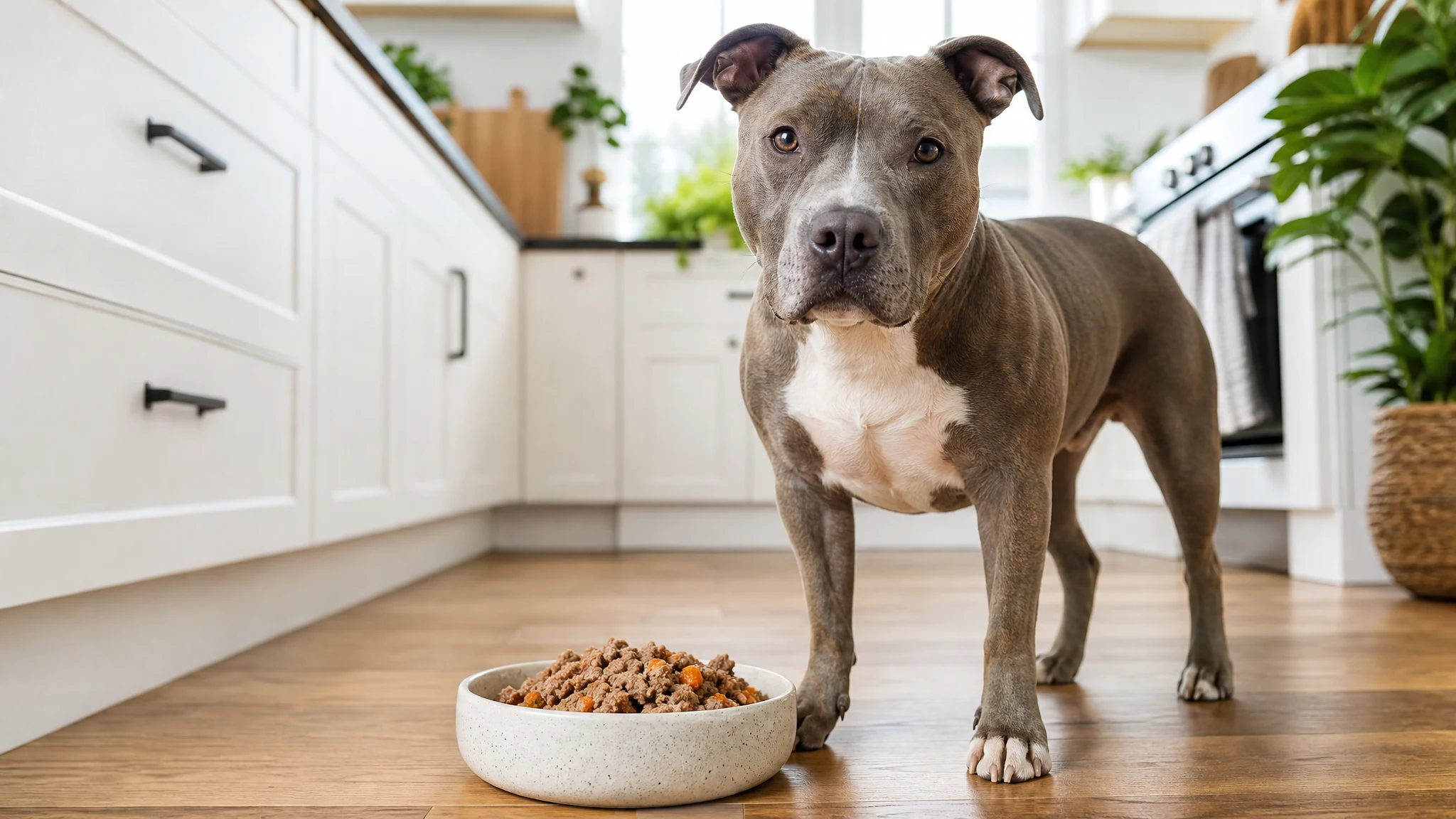
General nutrition information compiled from product labels and published sources, not veterinary advice. Your veterinarian is the right person to choose a diet for your dog, especially one with a health condition.
Many food bags promise a happy gut. Few say what that means. This guide shows you how to read the label on a bag or can, so you can judge any food for your Pit Bull without leaning on front-of-package claims.
A label cannot tell you how your dog's stomach will react. It can tell you what the food is, who it is made for, and how much energy is in it. A veterinarian decides what suits an individual dog, especially one with ongoing digestive trouble.
Start with what a Pit Bull is
The United Kennel Club lists the American Pit Bull Terrier as a medium breed. Its breed standard gives adult males about 35 to 60 lb and females about 30 to 50 lb. Hill's Pet Nutrition's breed page gives a similar range of 30 to 60 lb, with males heavier.
The UKC name matters here. "Pit Bull" is a type of dog, not a single registry breed, and plenty of dogs called Pit Bulls are mixes. Your dog's real size, age and activity matter more than the name, so use the weight on your own scale.
What you need
- The food bag, can or pack, or the brand's own product page.
- Your dog's current weight and age.
- A kitchen scale or measuring cup.
- A notebook for stool, appetite and energy notes.
- Your veterinarian's contact details, for questions about symptoms.
Step-by-step: how to read a label
1. Find the AAFCO statement
Look for the small paragraph that says the food is "complete and balanced." It names a life stage. Some foods say they meet the AAFCO Dog Food Nutrient Profiles. Others say animal feeding tests using AAFCO procedures support the claim. The two wordings are different methods, and both are worth noting.
No statement at all means the food may be a treat or topper, not a meal.
2. Match the life stage to your dog
Royal Canin UK gives about 12 months as general guidance for when medium-sized dogs move to an adult diet. No Pit Bull specific age was found, so ask your veterinarian about your own dog's timing.
Watch for foods that say they are not for puppies. Hill's Science Diet Adult Large Breed, for example, states it is not recommended for large breed puppies or pregnant or nursing dogs.
3. Decide whether "large breed" applies
Dog Food Advisor, quoting AAFCO label language, explains that growth and all-life-stages foods must state whether they include growth of large size dogs, meaning 70 lb or more as an adult. Whole Dog Journal reports a stricter calcium maximum of 1.8% dry matter for large breed puppy diets, versus 2.5% for other foods. Both are secondary sources.
Most Pit Bulls are under 70 lb, so the large-breed puppy rule generally does not apply. Some nutritionists use 50 lb as a cutoff, so a very big male may sit near it. Your veterinarian should confirm.
4. Read the first five ingredients
Ingredients are listed by weight before cooking. The first five show the base of the recipe. Note the main protein, such as chicken, beef meal or chicken by-product meal. Then note the main carbohydrate, such as rice, barley, sorghum, millet or potato.
Do not assume one ingredient is good or bad for the gut. A food that suits one dog may not suit another. What you can do is record the list so you can compare it later if your dog's stool changes.
5. Check the guaranteed analysis
The guaranteed analysis gives minimum protein and fat and maximum fiber and moisture. Brands differ in how they report these. Some Hill's pages give dry matter averages, which are not the same as guaranteed minimums. Do not compare those two kinds of numbers side by side as if they were equal.
6. Compare calories, not just cups
Calories per cup vary a lot between foods. A cup of one food can hold well over a cup's worth of energy from another. Check the calorie figure before you switch, so you do not overfeed by accident. Hill's lists weight management as a diet-relevant topic for the breed on its Pit Bull page, so portion size is worth watching.
7. Treat feeding charts as a starting point
Each brand's chart is a guide. Royal Canin says grams are the most accurate form of measurement. Hill's says to adjust amounts to maintain optimal weight. Weigh the food if you can, then adjust with your veterinarian's advice.
8. Switch slowly
Hill's puppy page suggests transitioning over 7 days by mixing increasing amounts of the new food with decreasing amounts of the old. Keep notes during that week. If you see ongoing vomiting, loose stool or low appetite, call your veterinarian.
A label-data comparison
The table below compares what these brands publish on their own pages. We compared label data only. We did not run feeding trials or taste tests, and nothing here shows how any food affects digestion. Foods are listed because they appear in our research, not because they are recommended.
| Food | Form | Life stage on label | Protein / fat | Calories | First ingredients |
|---|---|---|---|---|---|
| Royal Canin Medium Adult | Dry | Adult, 12 months and older, 23 to 55 lb | 23% min / 12% min | 340 kcal per cup | Brewers rice, chicken by-product meal, oat groats, wheat, corn protein meal |
| Hill's Science Diet Adult Large Breed Chicken & Barley | Dry | Adult large breed, 1 to 5 years, ideal weight 55 to 110 lb | 23.8% / 15% (dry matter averages) | 365 kcal per cup | Chicken, cracked pearled barley, brown rice, brewers rice, whole grain wheat |
| Victor High Energy | Dry | All life stages except growth of large size dogs | 24% min / 20% min | 412 kcal per cup | Beef meal, grain sorghum, whole grain millet, chicken fat, chicken meal |
| Freshpet Vital Chicken Recipe | Fresh | All life stages, including large size dog growth | 9.5% min / 7% min | No per-cup figure; 309 kcal per 1/2 lb | Chicken, chicken liver, peas, carrots, chicken broth |
| Nom Nom Beef Mash | Fresh | All life stages, including large size dog growth | 8% min / 5% min | 201 kcal per cup | Ground beef, russet potatoes, eggs, carrots, peas |
Dry and fresh foods hold very different amounts of water, so their protein and fat percentages are not directly comparable. Moisture changes the math, which is why calories and the AAFCO statement are better first checks.
Kibble size was not listed on the brand pages we reviewed. Royal Canin says only that its Large Adult kibble is designed for large jaws. If kibble size matters for your dog, ask the brand.
For a wider view of options, see our Pit Bull foods compared by label data.
Tips
- Change one thing at a time. If you switch food and add a new treat the same week, you will not know which one caused a change.
- Keep the old bag's label. A photo helps if you need to go back.
- Ask the brand directly about anything the page does not state, such as probiotic content or kibble size. Do not assume.
- Bring your notes and the label photo to the vet visit.
Common mistakes
- Trusting front-of-bag words. "Gentle," "digestive" and "natural" are marketing terms. The AAFCO statement and ingredient list are the parts you can check.
- Buying a large-breed formula by default. A medium Pit Bull may not need it. Check the life stage statement and your dog's weight.
- Comparing mismatched numbers. Dry matter averages, as-fed minimums and per-can calories are different measures.
- Switching all at once. A fast change is a common reason for an upset stomach.
- Using food to manage a medical problem on your own. Hill's lists skin allergies and hip and elbow dysplasia among health topics for the breed. A veterinarian decides whether any diet is appropriate. Prescription diets are only for a veterinarian to prescribe.
What to expect
A good label check may help you narrow your choices and avoid a poor match for your dog's age and size. During a slow switch, many owners look for steady appetite, normal energy and well-formed stools. Results vary from dog to dog, and no food is certain to change how a dog's gut behaves.
Call your veterinarian if your dog has repeated vomiting, blood in stool, diarrhea that lasts more than a day or two, weight loss, or seems unwell.
The takeaway
The best dog food for gut health is not something a label can promise. What you can do is choose a food with a clear AAFCO statement, a life stage that fits your dog, and calorie and ingredient information you understand. Then change foods slowly, watch your dog and let your veterinarian guide the rest.
Sources
- United Kennel Club, American Pit Bull Terrier breed standard
- Hill's Pet Nutrition, American Pit Bull Terrier breed page
- Royal Canin UK, when to switch your puppy to an adult diet
- Dog Food Advisor, large breed puppy food and all life stages labels
- Whole Dog Journal, best large breed puppy food
- Royal Canin Medium Adult product page
- Hill's Science Diet Adult Large Breed product page
- Victor High Energy product page
- Freshpet Vital Chicken Recipe product page
- Nom Nom Beef Mash product page