Best Dog Food for Gut Health: Comparing Pit Bull-Friendly Labels
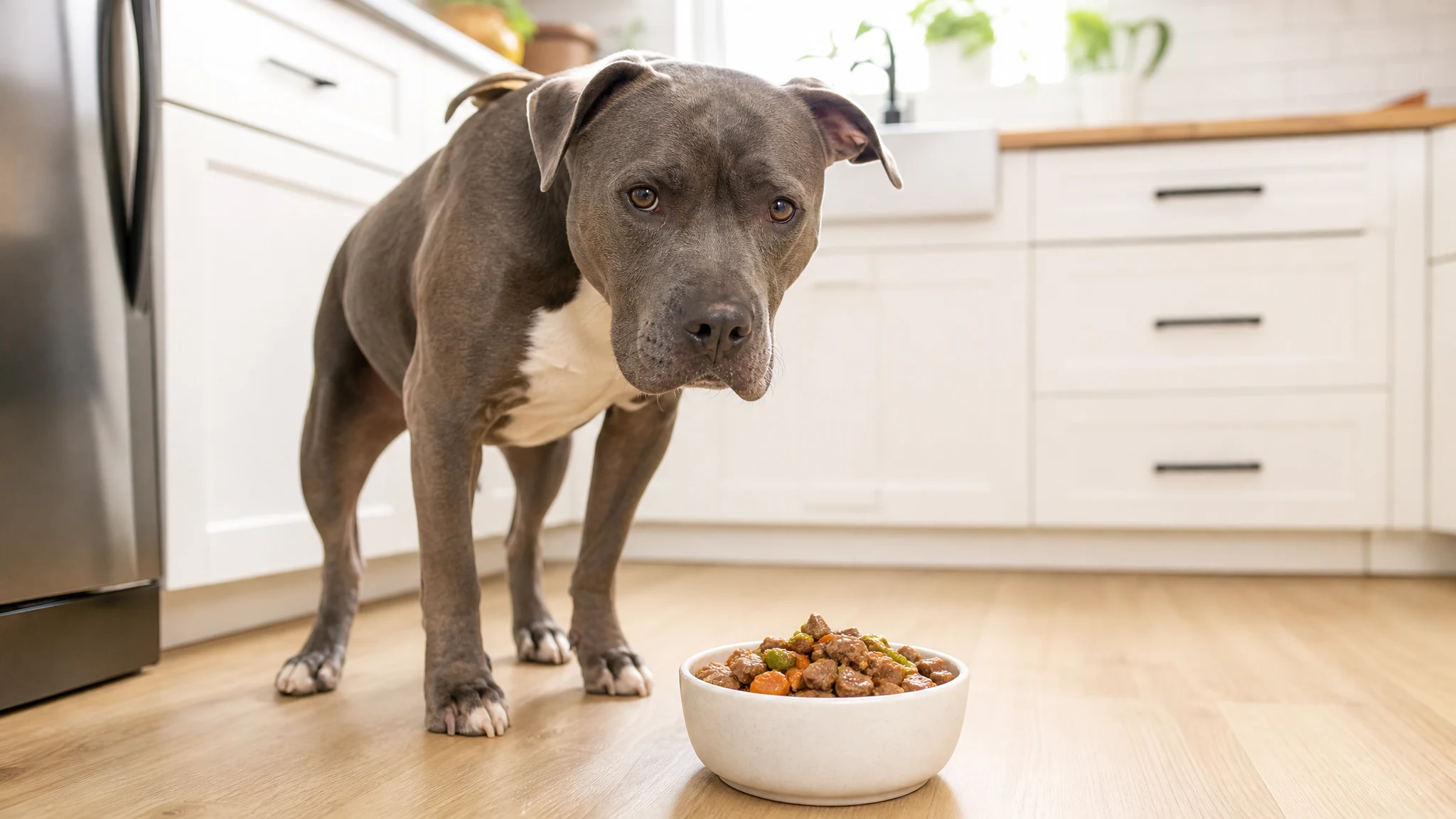
General nutrition information compiled from product labels and published sources, not veterinary advice. Your veterinarian is the right person to choose a diet for your dog, especially one with a health condition.
Pit Bull owners often ask for the best dog food for gut health. No label can promise a calm stomach, and no food can be called the winner for every dog. What you can do is read labels in a careful, repeatable way and bring the results to your veterinarian.
This guide shows that method step by step. It then applies it to nine real foods. We compared label data only. We did not run feeding trials or taste tests, and nothing here says a food prevents or treats any condition.
What you need before you start
- The bag or can of your dog's current food, or its brand page.
- The brand pages of the foods you want to compare.
- Your dog's current weight, age and body condition, ideally from your veterinarian's last visit.
- A notebook or spreadsheet to record the same fields for every food.
- A short list of questions for your veterinarian, especially if your dog has had vomiting, loose stools or gas.
For a wider comparison that is not focused on digestion, see our Pit Bull foods compared by label data.
Step 1: Know the dog you are feeding
"Pit Bull" is a type, not a single registry breed. The United Kennel Club lists the American Pit Bull Terrier as a medium dog. Its breed standard gives males 35 to 60 lb and females 30 to 50 lb. Hill's Pet Nutrition gives a similar range of 30 to 60 lb, with males heavier. Hill's also lists a life expectancy of 12 to 14 years.
Many Pit Bull type dogs are mixes, so your dog may not match these numbers. Write down your dog's actual weight. It decides which size-based formulas are even in range.
Hill's lists skin allergies (itchy skin and ear infections), hip and elbow dysplasia, and weight management among the diet-relevant concerns for the breed. Food reactions can show up in the gut and the skin. A dog with ongoing digestive or skin signs needs a veterinary exam first, not a bag swap.
Step 2: Match the life stage
Find the AAFCO statement on the label. It says whether the food is complete and balanced for maintenance, growth or all life stages. A food for the wrong stage can cause problems no matter how it is marketed.
Royal Canin UK gives about 12 months as the general switch point from puppy to adult food for medium-sized breeds. It does not give a Pit Bull specific age, so ask your veterinarian.
Size matters for puppies too. AAFCO requires growth and all-life-stages foods to say whether they cover growth of large dogs, meaning 70 lb or more as an adult. Dog Food Advisor, quoting AAFCO label language, notes that large-breed growth foods carry a stricter calcium maximum of 1.8% on a dry matter basis, versus 2.5% for other foods. Most Pit Bulls fall below 70 lb. Whole Dog Journal notes that some nutritionists use 50 lb as the cutoff, so a very big dog may be near the line. Your veterinarian should confirm which applies.
Step 3: Record the numbers the label gives
For each food, write down the AAFCO statement, protein, fat, fiber, calories per cup and the first five ingredients. Mark anything the brand does not publish as "unknown" instead of guessing. Kibble size, for example, was not given on the pages we compared.
Two cautions apply. First, Hill's pages give protein, fat and fiber as dry matter averages, not guaranteed minimums, so those figures are not directly comparable to minimums on other labels. Second, wet and fresh foods contain a lot of water. Their as-fed percentages look low next to kibble, but that mostly reflects moisture, not poorer quality.
Step 4: Compare the foods side by side
This table uses each brand's own published label data. Protein and fat are guaranteed minimums unless noted.
| Food | Form | Life stage per label | Protein / fat | Calories |
|---|---|---|---|---|
| Royal Canin Medium Adult | Dry | Adult, 12 months and older, 23 to 55 lb | 23% / 12% | 340 kcal per cup |
| Royal Canin Large Adult | Dry | Adult, over 15 months, 56 to 100 lb | 24% / 15% | 360 kcal per cup |
| Hill's Science Diet Adult Large Breed Chicken & Barley | Dry | Adult, large breed, ideal weight 55 to 110 lb | 23.8% / 15% (dry matter averages) | 365 kcal per cup |
| Hill's Science Diet Puppy Large Breed Chicken & Brown Rice | Dry | Growth, large breed puppies over 55 lb as adults | 26.7% / 15.4% (dry matter averages) | 387 kcal per cup |
| Hill's Science Diet Adult Chicken & Barley Entree | Wet | Adult, 1 to 6 years | 26.7% / 16.7% (dry matter averages) | 369 kcal per 13 oz can |
| Victor Hi-Pro Plus | Dry | All life stages except large-dog growth | 30% / 20% | 406 kcal per cup |
| Victor High Energy | Dry | All life stages except large-dog growth | 24% / 20% | 412 kcal per cup |
| Freshpet Vital Chicken Recipe with Peas, Carrots & Brown Rice | Fresh | All life stages, including large-dog growth | 9.5% / 7% | No per-cup figure; 309 kcal per 1/2 lb |
| Nom Nom Beef Mash | Fresh | All life stages, including large-dog growth | 8% / 5% | 201 kcal per cup |
| JustFoodForDogs Beef & Russet Potato | Fresh frozen | Adult maintenance only | 8.5% / 7% | No per-cup figure; 44 kcal per oz |
First five ingredients, as listed
- Royal Canin Medium Adult: brewers rice, chicken by-product meal, oat groats, wheat, corn protein meal.
- Royal Canin Large Adult: chicken by-product meal, brewers rice, wheat, brown rice, chicken fat.
- Hill's Adult Large Breed: chicken, cracked pearled barley, brown rice, brewers rice, whole grain wheat.
- Hill's Puppy Large Breed: chicken, brown rice, whole grain oats, chicken meal, cracked pearled barley.
- Hill's Adult Chicken & Barley wet: water, chicken, pork liver, whole grain corn, cracked pearled barley.
- Victor Hi-Pro Plus: beef meal, grain sorghum, chicken fat, whole grain millet, blood meal.
- Victor High Energy: beef meal, grain sorghum, whole grain millet, chicken fat, chicken meal.
- Freshpet Vital Chicken: chicken, chicken liver, peas, carrots, chicken broth.
- Nom Nom Beef Mash: ground beef, russet potatoes, eggs, carrots, peas.
- JustFoodForDogs Beef & Russet Potato: beef, beef liver, russet potatoes, sweet potatoes, carrots.
Step 5: Read the table for fit, not for a winner
Start with size and stage. Royal Canin Medium Adult is labeled for 23 to 55 lb, which covers most Pit Bulls. The large formulas start at 55 or 56 lb, so they are mainly relevant to the heaviest dogs. The Hill's large breed puppy food is labeled for dogs over 55 lb as adults, and Hill's says it is not for adult dogs.
Next, look at energy. Victor's two foods carry about 406 and 412 kcal per cup, well above Royal Canin Medium at 340. A cup of one food is not a cup of another. Switching by volume without adjusting can change how much energy your dog gets, and that is a common source of digestive upset and weight change.
Then look at ingredient style. Some foods lead with named meat, some with rice or sorghum, and some list a by-product meal. These are label facts, not verdicts. None of the sources we used says one style is better for a Pit Bull's gut. If your dog has a known food sensitivity, your veterinarian can guide which ingredients to avoid.
Last, check what the label does not say. None of these pages makes a gut health claim we can verify here. If a brand mentions digestive support, ask the brand what the claim rests on, and ask your veterinarian whether it matters for your dog.
Step 6: Use the feeding guide as a starting point
Feeding charts are starting points. Hill's chart for its Adult Large Breed food lists 3 1/4 cups per day for a 50 lb dog. Royal Canin's Large Adult page lists about 3 3/8 cups (318 g) for a 57 lb dog at moderate activity. Royal Canin also notes that grams are the most accurate measure, and cups are approximate. Nom Nom says its recommendations may vary with age, weight and activity. Adjust to your dog's body condition, with your veterinarian's input.
Step 7: Switch slowly
Hill's suggests a 7-day transition on its puppy food page, mixing increasing amounts of the new food with decreasing amounts of the old. Many owners use a similar pattern for any change. Change one thing at a time, so that if stools or appetite change, you know the likely cause.
Tips
- Keep notes on stool quality, appetite and energy for a couple of weeks before and after a change.
- Weigh the food in grams if the brand offers gram amounts.
- Count treats and chews in the daily total.
- Check the brand page again before buying. Formulas and label data can change.
- Ask your veterinarian before trying fresh or home-prepared diets, since some are labeled for maintenance only.
Common mistakes
- Comparing percentages across food types. Dry, wet and fresh foods differ in moisture.
- Treating dry matter averages as minimums. Hill's lists averages, not guarantees.
- Ignoring life stage. A large breed puppy food is not for adults, and a maintenance food is not for growing puppies.
- Switching too fast. A sudden change can be the cause of the upset you are trying to fix.
- Assuming grain free means gentler. The label does not say that, and only one fresh food in this comparison is marked grain free.
- Self-treating ongoing symptoms. Persistent vomiting, diarrhea or weight loss needs a veterinary visit. Prescription diets are something only a veterinarian prescribes.
What to expect
Careful label comparison may help you pick a food that suits your dog's size, life stage and calorie needs. Some dogs settle well on a steady, appropriate diet, while others need more investigation. Results vary, and no food can be promised to change digestion. If stools stay loose, or your dog seems unwell, talk with your veterinarian. They decide what is right for an individual dog.
Sources
- United Kennel Club, American Pit Bull Terrier breed standard
- Hill's Pet Nutrition, American Pit Bull Terrier breed page
- Royal Canin UK, when to switch your puppy to an adult diet
- Whole Dog Journal, best large breed puppy food
- Dog Food Advisor, large breed puppy food and all life stages labels
- Royal Canin Medium Adult
- Royal Canin Large Adult
- Hill's Science Diet Adult Large Breed
- Hill's Science Diet Puppy Large Breed
- Hill's Science Diet Adult Chicken & Barley Entree
- Victor Hi-Pro Plus
- Victor High Energy
- Freshpet Vital Chicken Recipe
- Nom Nom Beef Mash
- JustFoodForDogs Beef & Russet Potato Recipe