4Health Dog Food for Pit Bulls: How It Compares on the Label
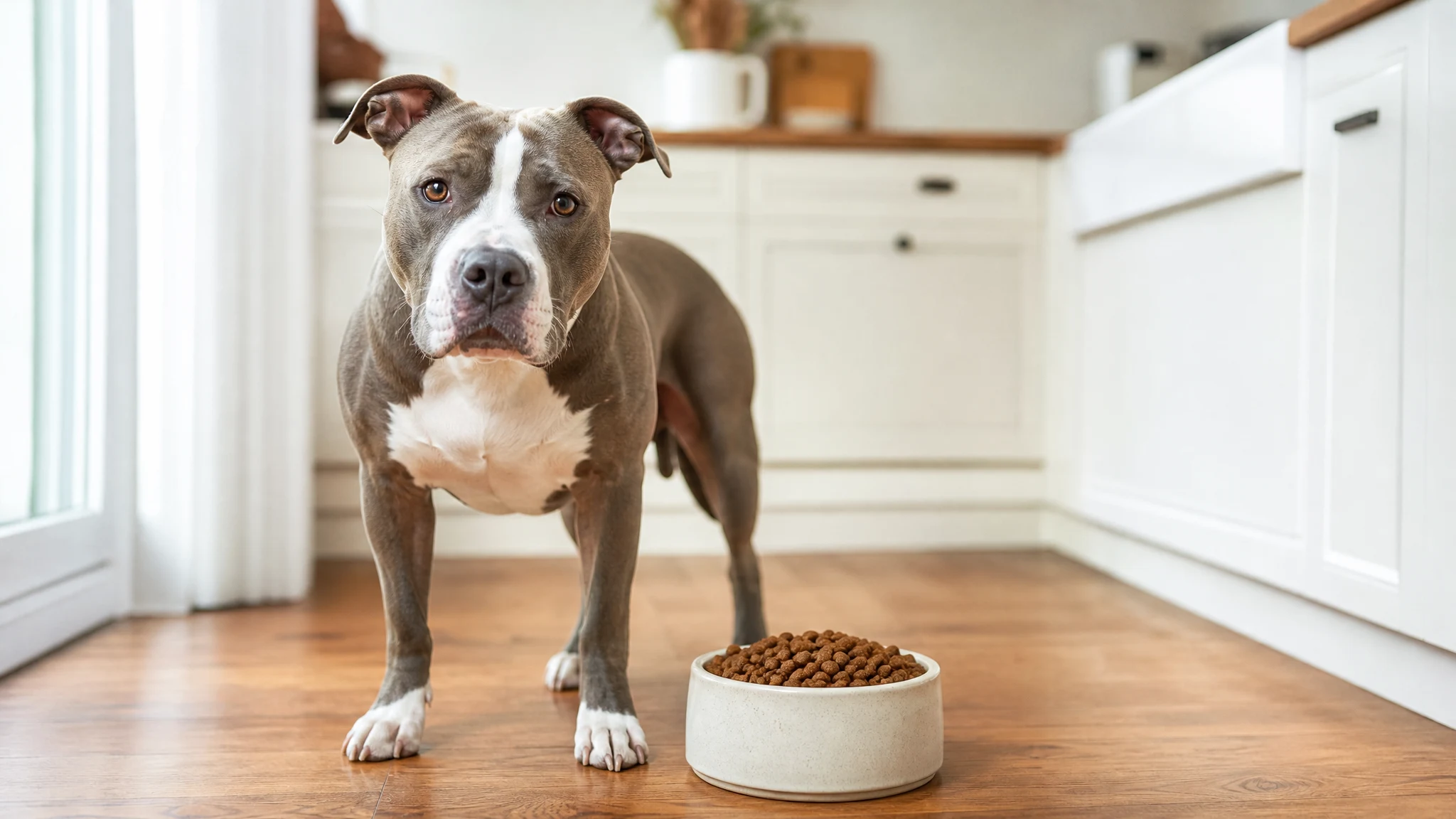
General nutrition information compiled from product labels and published sources, not veterinary advice. Your veterinarian is the right person to choose a diet for your dog, especially one with a health condition.
Comparing 4health dog food with other brands comes down to reading the same few label items in the same order. This guide shows you how to do that for a Pit Bull, and gives side-by-side label data for several brands you can use as a yardstick.
One honest note first. The 4health label details are not in the research behind this page, so we do not quote its protein, fat, calories or ingredients. Pull those from the bag or the brand's own product page, then use the steps below to line them up against the examples.
How we compared
We compared label data only. That means the AAFCO statement, life stage, guaranteed analysis, calories and first ingredients as printed on each brand's own page. We did not run feeding trials or taste tests, and we have not fed these foods to dogs. A label tells you what a food is formulated to be. It does not tell you how your dog will do on it.
For a wider table of brands, see our foods compared by label data.
What you need
- The 4health bag, or the product page from the brand's own site.
- Your dog's current weight and age, ideally from your veterinarian's last visit.
- A pen and paper, or a simple spreadsheet.
- A kitchen scale, so you can weigh portions in grams instead of guessing in cups.
Step 1: Know the dog you are feeding
"Pit Bull" is a type of dog, not one registry breed. The United Kennel Club lists the American Pit Bull Terrier as a medium-sized breed. Its breed standard puts males at 35 to 60 lb and females at 30 to 50 lb. Hill's Pet Nutrition gives a range of 30 to 60 lb, with males heavier.
Write down your own dog's weight and age. Many Pit Bulls and Pit Bull mixes fall outside the standard, so your dog's actual numbers matter more than the breed range.
Step 2: Check the AAFCO statement and life stage
Find the sentence that begins with something like "formulated to meet the nutritional levels established by the AAFCO Dog Food Nutrient Profiles." It names a life stage: maintenance (adult), growth, or all life stages.
Also look for the large-size wording. According to Dog Food Advisor, quoting AAFCO label language, growth and all-life-stages foods must say whether they include or exclude growth of large-size dogs, meaning 70 lb or more as an adult. Most Pit Bulls are below that line, so a food that excludes large-size growth is not automatically wrong for a Pit Bull puppy. Some nutritionists use 50 lb as the large-breed cutoff, according to Whole Dog Journal, so a very big individual may sit near it. Ask your veterinarian to confirm which puppy food suits your dog.
Royal Canin UK gives about 12 months as the general switch point to an adult diet for medium breeds. No Pit Bull specific age was found, so your veterinarian can advise on timing.
Step 3: Read the guaranteed analysis
Record the minimum crude protein, minimum crude fat and maximum crude fiber. These are floors and ceilings, not exact amounts. Some brands, such as Hill's Science Diet, publish dry matter averages on the web page instead of guaranteed minimums. Do not treat an average as a minimum.
Step 4: Note calories per cup
Calories per cup vary a lot between foods, so the same cup of two foods is not the same meal. Look for kcal per cup, or kcal per kilogram if the cup figure is missing. Some fresh foods list calories per pack or per half pound, which cannot be compared to a cup figure without converting.
Step 5: Read the first five ingredients
Ingredients are listed by weight before cooking, so the first few tell you the base of the recipe. Note whether the list starts with a named meat, a meal or by-product meal, or a grain. None of these is automatically good or bad. It is a description of the recipe, and marketing words on the front of the bag do not replace it.
Step 6: Put 4health next to the examples
Add a row for 4health using your own notes. Here are the label figures from each brand's own page to compare against.
| Food | Label life stage | Protein / fat (min) | Calories | First ingredients |
|---|---|---|---|---|
| Royal Canin Medium Adult (dry) | Maintenance, 12 months and older, 23 to 55 lb | 23% / 12% | 340 kcal per cup | Brewers rice, chicken by-product meal, oat groats, wheat, corn protein meal |
| Royal Canin Large Adult (dry) | Maintenance, over 15 months, 56 to 100 lb | 24% / 15% | 360 kcal per cup | Chicken by-product meal, brewers rice, wheat, brown rice, chicken fat |
| Hill's Science Diet Adult Large Breed Chicken & Barley (dry) | Maintenance, large breed 1 to 5 years | Minimums not listed; 23.8% / 15% dry matter averages | 365 kcal per cup | Chicken, cracked pearled barley, brown rice, brewers rice, whole grain wheat |
| Victor Hi-Pro Plus (dry) | All life stages, except growth of large-size dogs | 30% / 20% | 406 kcal per cup | Beef meal, grain sorghum, chicken fat, whole grain millet, blood meal |
| Victor High Energy (dry) | All life stages, except growth of large-size dogs | 24% / 20% | 412 kcal per cup | Beef meal, grain sorghum, whole grain millet, chicken fat, chicken meal |
| Freshpet Vital Chicken Recipe (fresh) | All life stages, including large-size growth | 9.5% / 7% | No per-cup figure given | Chicken, chicken liver, peas, carrots, chicken broth |
| Nom Nom Beef Mash (fresh) | All life stages, including large-size growth | 8% / 5% | 201 kcal per cup | Ground beef, russet potatoes, eggs, carrots, peas |
Do not compare the protein of a fresh food directly with a dry food. Fresh foods contain far more water, so their percentages look low. The numbers are only comparable on a dry matter basis, and the brand's page or the manufacturer can help you convert them.
Step 7: Use the feeding guide as a starting point
Every brand's feeding chart is a starting estimate. Royal Canin's page gives about 3 3/8 cups (318 g) a day for a 57 lb dog at moderate activity on its Large Adult food. Hill's gives 3 1/4 cups a day for a 50 lb dog on its Adult Large Breed food. Those two foods differ in calories per cup, which shows why you should follow the chart on the food you actually buy.
Weigh the portion, watch your dog's body shape over several weeks, and adjust with your veterinarian's guidance. Hill's lists weight management and lean muscle as diet-relevant concerns for the breed, so tracking body condition is worth the effort.
Step 8: Switch slowly
If you change foods, Hill's suggests mixing increasing amounts of the new food with decreasing amounts of the old over 7 days. That is a sensible pace for most foods. Follow the instructions on the new food's own page if they differ.
Tips
- Compare like with like: dry with dry, adult with adult, puppy with puppy.
- Check whether a number is a guaranteed minimum or only an average.
- Look for kibble size on the brand's page. Several brands do not publish it, so ask the brand if it matters for your dog.
- Keep your notes dated, since brands can change recipes.
Common mistakes
- Judging by the front of the bag. Photos and slogans are marketing. The AAFCO statement and ingredient list are the parts that carry rules.
- Assuming a "Pit Bull" formula exists. None turned up in the label data we compared. Be skeptical of any food that claims one.
- Feeding a large-breed puppy food to a medium dog without asking. Hill's large-breed puppy food is labeled for dogs over 55 lb as adults. Your veterinarian can say whether that suits your puppy.
- Treating a food as a fix for a health problem. Hill's lists hip and elbow dysplasia and skin allergies, with itchy skin and ear infections, among the concerns for the breed. A veterinarian decides diet for an individual dog, and prescription diets are only prescribed by a veterinarian.
- Reading cups as exact. Royal Canin's own note says grams are the most accurate way to measure.
What to expect
After working through these steps, you should have a clear one-page comparison of 4health against other foods. It may help you spot differences in calories, protein, fat and recipe style, and make a more informed conversation with your veterinarian. A label comparison cannot predict how your dog will digest or enjoy a food, or whether it will improve any health concern. Watch your dog's energy, stool, coat and weight, and report changes to your veterinarian.
Sources
- United Kennel Club, American Pit Bull Terrier breed standard
- Hill's Pet Nutrition, American Pit Bull Terrier breed page
- Royal Canin Medium Adult
- Royal Canin Large Adult
- Royal Canin UK, when to switch your puppy to an adult diet
- Hill's Science Diet Adult Large Breed
- Hill's Science Diet Puppy Large Breed
- Victor Hi-Pro Plus
- Victor High Energy
- Freshpet Vital Chicken Recipe
- Nom Nom Beef Mash
- Dog Food Advisor, large breed puppy food and all life stages labels
- Whole Dog Journal, best large breed puppy food